Dyed-In-The-Wool History

The CIA and Regime Change 1947-65
Jim Pederson Dyed-In-the-Wool History February 15, 2025
The Office of Strategic Services (OSS)
The CIA was established in 1947 and evolved from the OSS that was established in 1942 during WWII. Prior to that the United States had never had a permanent organization dedicated to intelligence gathering and espionage and selling the idea wasn’t easy. Following WWI the American public generally thought the war was a mistake and there was broad opposition to it prior to the war outside northern elites that were largely Anglophiles. The idea of a secret intelligence agency would seem to pave the way for future foreign wars and entanglements. Disdain for espionage wasn’t limited to the public but was also prominent in the government. In 1936 the Senate Committee on Education and Labor’s subcommittee Investigating Violations of Free Speech and the Rights of Labor (commonly referred to after its chairman La Follette) held a series of hearings that reinforced this position (1 p. 11).
Just prior to and during the early stages of WWII the government agencies were able to expand without the type of pushback that would have happened prior to that and the FBI became a real option for the creation of a central intelligence function. In May 1940, Jay Edgar Hoover called a meeting to discuss intelligence cooperation. Undersecretary of State Berle recorded his observations on the meeting saying: “We had a pleasant time coordinating, though I don’t see what the State Department has got to do with it.”(1 p. 16) Those seeking to construct an intelligence agency, not having a model in American history, started to look towards the British who had a long and storied history of foreign meddling, intelligence gathering and, arguably, regime change although this always maintained some element of plausible denial. In England the domestic agency, MI5, and its foreign intelligence counterpart, MI6 had received significant cuts in the era between the wars so there was some natural synergy between England, that sought additional resources, and the US that wanted to enter the game and understand how it was played (1 p. 16) .
The Office of Strategic Services (OSS) was established by executive order on 11 July 1942 and was structurally and in terms of its mission, an extension of the military. The OSS existed to gather intelligence or derive the truth but would also distort the truth through “black” propaganda and became involved in regime change, both of which would become characteristics of the CIA. It also did a good deal of self-promotion and became increasingly adept at it. The OSS presented itself to indigenous peoples as champion of anti-colonialisms, unlike France and Britain, and while this image may have been more self serving than real (1 p. 22), there were key people in the OSS who were more in line with FDR’s vision of a cooperative post war future than the aggressive cold war mentality that would be characteristic of the CIA. Archimedes Patti in Viet Nam worked closely with Ho Chi Minh and the Viet Minh prior to the US siding with the French (2) and in China the OSS was to some degree supportive of the “China Hands” in the State Department who opposed the US policy of working with and supporting only Chiang Kai-Shek. (3)
The image to the right is Archimedes Patti taken on station at the OSS field office in Vietnam in 1945
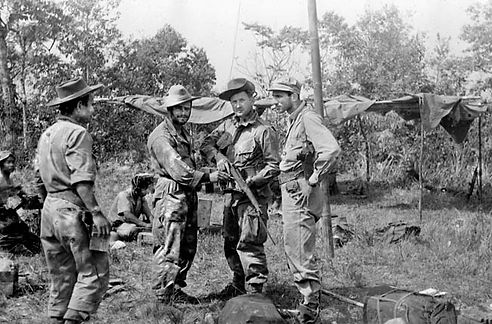
To the left are OSS officers in the Burmese jungle in that last phases of WWII. The OSS was significantly active in the region as that Japanese were driven out and struggles arose in what were previously colonial areas.

The National Security Act of 1947 and Creation of the CIA
In 1947 the CIA was established as the world’s first democratically sanctioned secret service. The US public had accepted the belief that interwar intelligence was too weak and fragmented leaving the nation vulnerable to external attack and were willing to accept the expense (and potentially risks) associated with a permanent intelligence service (1 pp. 10-11). Gallup polls showed a 77 percent public approval rating for the new agency. The democratic nature of the CIA’s establishment gave it instant authority and standing(4 p. 25) Other western democracies had intelligence agencies, but they were shrouded in secrecy. The British didn’t even acknowledge the existence of its foreign intelligence agency, MI6, or its counterintelligence outfit, MI5. The CIA would be created out of the OSS, which had established itself as a sort of “purposeful myth”, and produced four future directors—Allen Dulles, Richard Helms, William Colby, and William Casey along with a host of lower-ranking officers. The CIA owed their culture, character, and history to the wartime OSS. (1 p. 19) Truman terminated the OSS on 20 September 1945 which was not a difficult task as he did not admire either the organization or its director, William Donovan. (1 p. 23)
The provision to create the CIA, which was included in the National Security Act of 1947, happened because of public and congressional support but the support didn’t have much to do with a perceived Soviet threat of the developing Cold War, which weren’t even mentioned in the congressional debates. It was rather based in the initiation of WWII with legislators being convinced that better US intelligence would have saved the nation from Pearl Harbor. The original purpose of the CIA was to prevent future shocks of this nature but even this belief was seriously flawed (1). The American public and its political leadership prior to WWII had been sold the belief, largely thanks to the “China Lobby”, that the oil supply to Japan could be cut off without any ramifications (3). FDR, to his credit, realized that this would cause the Japanese to move towards Southeast Asia and would result in a military confrontation (“hot war”) but failed to anticipate an attack of that magnitude or its location (5). The attack occurred due, not so much to a detailed intelligence failure, as to a widely held (obviously) false assumption or belief.
After its creation the CIA was slow to develop much of an intelligence capability that could predict future threats but it focused on spying operations and influencing foreign governments that would eventually extend to regime change. CIA covert actions would become what author Rhodri Jeffery-Jones would describe as “a gradually evolving disaster”(1 pp. 31-32) . It would destroy America’s moral authority globally and, to a lesser extent, domestically and alienate most countries in the world. The Peacetime covert operations of the CIA were chartered by a series of directives from the newly formed National Security Council starting with NSC 10/2, issued in June 1948 that established an office of special projects that would supply the bureaucracy to administer dirty tricks. It gave the CIA broad general powers to carry out covert operations. These specifically included “propaganda, economic warfare, preventive direct action including sabotage, anti-sabotage, demolition and evacuation measures; subversion against hostile states including assistance to underground resistance movements, guerrillas, and refugee liberation groups” (6 p. 293). The last of the series of directives that gradually expanded the ability of the CIA to conduct foreign operations was NSC 5412/2 in December 1955 that defined the program’s aims. It opened stating that the CIA took “cognizance of the vicious activities of the USSR and Communist China.” It went on to say that the CIA would undertake “covert operations” that would create “troublesome problems for International Communism” (1 p. 34). Two notable points here is that it assumed that “international communism”, which basically equated to Russia, had an intent and capability to expand and that if that threat did not exist or was not acknowledged, the justification for most of the organization’s functions would also be gone.
So how did the United States create such a capability that would seem to be so foreign to the founding concepts of the nation? The National Security Act of 1947 (7 pp. 33-5) created the infrastructure and organization and specifically chartered the National Security Resources Board (NSRB), the Munitions Board, the Research and Development Board, the Office of the Secretary of Defense, the Joint Chiefs of Staff, along with the Central Intelligence Agency. Secretary of State George Marshall warned President Truman that this measure would grant the new intelligence powers that were ”almost unlimited” (8). Truman would eventually concede this point but only after the assassination of John Kennedy. The CIA by 1950 had become a paramilitary organization outside of the control of the elected government. George Kennan, who was a major Cold War figure who has appeared in the narrative at many other points up to this stage of the story, sponsored NSC 10/2 but said later in the light of history that this was the “the greatest mistake I ever made” (6 p. 293). Because NSC 10/2 authorized violation of US and international laws, it by inference authorized fabricated cover stories. CIA missions were to be “so planned and executed that any US government responsibility for them is not evident to unauthorized persons, and that if uncovered the US government can plausibly deny any responsibility for them.” (6 p. 293)
US presidents over time became more accepting of the CIA’s ability to “fix” international problems. Presidents and their advisers came to see covert action as a permanently useful tool and component of America’s global strategy(1 p. 34). This would increase the agency’s power to approach that of an independent unelected shadow government. The guiding strategy would have been described as the opposition to imperialism of totalitarian states, which in practice meant the Soviet Union and China. The accuracy or validity of this mission was a subject of political debate at the time that inherently tended to cause the US to take on the characteristics of what they claimed to oppose and, over time turned the accusation into projection. George Kennan understood this saying of Russia, “At the bottom of Kremlin’s neurotic view of world affairs is traditional and instinctive Russian sense of insecurity.” (9) From the time Stalin deposed of Trotsky the Russians weren’t philosophical communists bent on world revolution but were rather Russian nationalist that sought to protect Russia and had acquired certain paradigms as lessons learned from a series of European invasions. Russia was ever fearful of being overrun by its neighbors and losing access to ocean trade routes and aggressively determined to surround itself with Moscow-aligned buffer states.


Above is a picture of Truman signing an amendment to the National Security Act of 1947 (military-history-fandom)
To the left is the last page of the National Security Act of 1947 with Truman's signature (Wikipedia)
Managing the American Media and “Operation Mockingbird”
Because the CIA’s war on communism could be logically extended to left leaning ideologies, movements, and positions in America the mission had a natural drift in that direction and would create some degree of overlap with the FBI. Because communists (and many others) had advocated for civil rights in the United States, the CIA supported a front organization called the Africa-America Institute(1 pp. 38-40). The Congress for Cultural Freedom paid for exhibitions, performances, and prizes that enticed artists and performers and influenced their message and content. The goal was to weaken one ideology, communism, and to indirectly promote another, capitalism. Europeans were especially incensed that the CIA’s taken a direct role in culture with free expression giving way to sponsored content that was not labeled as such. Known and influential journalists like Joseph Alsop worked with and for the CIA and he was by no means alone. The CIA was in the publishing business producing over one thousand books. (1 pp. 38-40)
Operation Mockingbird was an alleged large scale umbrella project beginning in the early Cold War years to manipulate domestic media the disclosure of which was tied to the Church Committee in 1975 however, the depth of the information made public by the committee left much unresolved. Much has been written about it since but, unlike so many other CIA misadventures, this one is not entirely defined and would have to be considered “alleged” as opposed to fully proven. The most ominous aspect of Mockingbird, however, is that it didn’t have an end date and more recent disclosures have indicated that it just expanded with time.
During the 1950s the CIA allegedly rolled out Operation Mockingbird which was initially organized by Cord Meyer and Allen Dulles for promoting views that the CIA determined to be in the best interest of the country or the agency. This funded a few magazines and other CIA front publications with federal taxpayer money. The specific tasks included general propaganda, subversion against hostile states, assistance to underground resistance groups, and support of indigenous anti-communist groups in accordance with the agency’s charter (10) (11 p. 57) In the early days this was somewhat constrained being limited to planting stories, and coercing journalists to cooperate by revealing sources. Correspondents returning from overseas commonly provided their notes and offered their impressions to agency personnel. (11 p. 58)
The Agency’s domestic activities created a power struggle with Hoover’s FBI that had similar operations. FBI agent William Sullivan wrote a book in 1979 titled “The Bureau: My Thirty Years in Hoover’s FBI.” Sullivan was an aide to Hoover but was forced to resign in 1971. Sullivan died in a hunting accident in 1977 just days before he was to testify in front of the House Select Committee on Assassinations. The book was in process when he was killed but his family published posthumously in 1979. (11 p. 58) Another convenient death was that of Frank Wisner who was a primary organizer of covert operations for the CIA. Wisner, who was somewhat boastful of his accomplishments, referred to Mockingbird as his “mighty Wurlitzer… a wondrous propaganda instrument he built, and played, with help from the press. “ (11 p. 59) Wisner eventually committed suicide. By the late 1950’s the CIA is alleged to have had prominent reporters at the New York Times, Newsweek, and CBS virtually under their control. Editors of several publications stated that they believed they were doing their patriotic duty in working with the agency and some of these news outlets actually created positions for active agents to work as reporters. (11 p. 59) By 1960 there were nearly 3,000 salaried and contract employees engaged in domestic media manipulation (12)(11 p. 59). A common strategy to manage the population was to create division by “fostering strict party affiliation among the people”. This forces people to choose one side or the other as “their team” and is a fairly clear example of attempting to manage society along the lines of the Hegelian Dialectic which holds that society can be controlled through multiple managed conflicts.
In assessing Operation Mockingbird there is no doubt that the CIA engaged in the sorts of activities described here. The remaining questions have to do only with the level of organization, duration, and specific assets that were used. As more documents are released, this will become clearer. The focus level and sophistication in dealing with media did, however evolve and became more directed at managing public perceptions in a broader sense. Author David P. Hadley describes more current trends in CIA media relationships as follows:
What is clear, however, is that the CIA’s approach to its public image has grown considerably more sophisticated in recent years. The CIA now seeks to ensure it is well represented in fiction and popular culture. As Richard Immerman has observed in his recent history of the agency, the CIA’s presence on film and television screens increased dramatically during the War on Terror. Those television shows and films often consult with the CIA. The CIA appointed its first official liaison to Hollywood in 1996. Many former employees are allowed to serve as consultants and extras. The CIA even hired the actor Jennifer Garner, known for playing a spy on the ABC program Alias, to star in a recruitment video.8 The CIA tried to use the domestic press to influence American public opinion. The agency wanted certain stories suppressed and a positive view of the agency to prevail. In this, their efforts were much like those of other, nonsecret government agencies. Its methods were relational and often ad hoc. Though the CIA paid some reporters for intelligence-related tasks, the relationships that promoted the image of the agency depended on personal ties and common understanding. There were often murky lines between cooperation and patriotic discretion, between the standard journalistic practice of gathering information and special collaboration to further the interest of a particular agency. (4 pp. 176-177)
Interference in European Politics
Moving beyond media and propaganda, the CIA started direct interventions in the politics of other nations with the cases of Italy and French the late 1940s and the 1950s being the most documented. The agency gave clandestine financial support to the preferred party or candidate, bought up ink supplies to prevent communist efforts to purchase printing presses, and influenced the media to tilt the playing field in the intended direction (1 p. 43). Involvement in Italy started in 1948 almost immediately after the signing of the National Security Act of 1947. According to CIA operative F. Frank Wyatt, "We had bags of money that we delivered to selected politicians, to defray their political expenses, their campaign expenses, for posters, for pamphlets." (13) To influence the 1948 election US agencies wrote ten thousand letters and Time magazine featured Christian Democratic candidate Alcide de Gasperi on its cover. These revelations became public knowledge as the result of the Pike Committees closed hearings in 1975 that were released to the press in 1976. It was believed, and may be true, that Russia was providing funding to the Italian communists (PCI) and, in addition to CIA managed resources, the Marshall Plan through the Economic Cooperation Administration funneled $10M to $20M into Italy specifically for anti-PCI purposes. (14 pp. 49-58) It is uncertain as to whether the CIA swung election results or not.
The CIA’s activities in France were similar to Italy focusing on media and infiltration of the political parties but the relationship of the agency with President Charles de Gaulle was especially contentious. De Gaulle in 1963 refused to meet with CIA director Allen Dulles and instead sent a delegate, Michel Debre, to meet Dulles. The CIA had app. 60 agents active in France at the time and DeGaulle suspected them of supporting rebellious generals in a coup attempt against him. The CIA’s operations in Europe were generally more constrained than in the rest of the world. Its “Health Alteration” assassination committee appeared not to be active in these nations. Outside of Europe and especially in “non-white” regions, the CIA engaged in more ruthless behavior in part because there was greater opportunity. (1 pp. 42-44)
The CIA’s first involvement in a proxy war took place in the Ukraine in circumstances that were in many ways similar to the Ukrainian / NATO war with Russia from 2022 to 2025. When the Germans invaded Russia in June of 1941 one of the more notable contingents of non-German Nazi’s was the Organization of Ukrainian Nationalists (OUN) led by Stephan Bandera who was to become an icon of Ukrainian nationalism in the decades following the war. Their role was to act as Ukrainian speaking policemen (15). Bandera hated communism and saw the Jews as the principal force behind the rise of Marxism stating, “The Jews of the Soviet Union are the most loyal supporters of the Bolshevik Regime and the vanguard of Muscovite imperialism in the Ukraine”(15). If this ever was true, after the Stalin purges, it no longer was. Of the Jewish deaths in the holocaust of WWII, app. 25% occurred in Ukraine (15). After the war Bandera and many of his core supporters lived out their lives in the west as intelligence assets. Bandera was eventually killed by the Soviets in 1959 but his self promotion would ensure that his legend would live on.(15)
As the Germans retreated OUN acted as resistance to the Soviet advance and were a key component in the genocide of Jews, Poles, and others. It is important to note that the holocaust largely happened in Poland in the later phases of the war. An OUN veteran from the time period is quoted as saying, “We slaughtered the Jews, we’ll slaughter the Poles, old and young, every one, we’ll slaughter the Poles, we’ll build Ukraine.” (16 p. 294)(17) After the defeat of Germans the OUN-UPA (Ukrainian Insurgent Army) continued fighting an insurgency and assassination war against the Soviets for the next decade operating out of the Carpathian Mountains with support from the US military and the CIA. The Russians eventually resolved this by relocating hundreds of thousands of people from the civilian population out of which the insurgency was based. It should be noted here that Stalin’s NKVD also engaged in ethnic cleansing and relocation campaigns during WWII. (16 p. 292)

To the left is a book image of a biography on Ukrainian Nationalist hero Stephan Bandera by Grzegorz Rossoliński-Liebe from Amazon
The link below is to a video on the OUN and genocide in the later stages of WWI and ongoing fighting after that which was CIA supported. The video is age restricted so it can't be embedded (https://www.youtube.com/watch?v=luFVfcW7yAE)
Regime Change in Iran and Guatemala
The first and most documented successful US initiated regime change in the post WWII era occurred in Iran in 1953 and it established a process that was subsequently refined over time. It also had long term negative side effects that well out-weighed the initial benefits which, likewise, has been a recurring pattern. Following WWII, Iranian anti-colonist, Mohammad Mosaddeq, was elected Prime minister promising to give the Iranian people a bigger portion of the oil profits going to British Petroleum (British Anglo-Iranian Oil Company). He was Time magazine Man of the Year in 1951 but his efforts made international enemies. Stories started appearing in the press connecting Mosaddeq to communists and the Soviet Union (18 pp. 18-19). This sort of branding was a recurring practice and tends to beg the question of whether the US targeted them because they were communists or labeled them communists because they advocated policies that were contrary to American economic interests.
Mosaddeq was removed from power by the CIA and the British MI6 in 1953. This is documented in an article in the Guardian in 2013 titled “CIA Admits Role in 1953 Iranian Coup” (19 p. 20). In his diary President Eisenhower also admits that the U.S. was the leader in the Iranian coup and expressed concern over the public’s reaction should the facts of this incident become known that would prevent other similar operations in the future (20 p. 220). CIA agent Kermit Roosevelt, who was President Theodore “Teddy” Roosevelt’s grandson, was a central figure in the plot. This was the first and last time the CIA would use one of its own agents as a point man for this sort of operation due to the risks and ramifications of being caught (19 p. 22). Shah Mohammed Reza Pahlavi was placed in charge which forced the British to share the spoils with five American petroleum companies, along with Royal Dutch Shell and a French petroleum company.
The August 1953 Iranian coup was a major victory for the CIA and became part of the agency’s culture and legacy. The CIA successfully defeated “nationalization” that could alternatively be seen as relating to nationalism or socialism which highlights a key similarity between fascism / nationalism and socialism. Prime Minister Mohammed Mosaddeq supported nationalization which ran directly against the interests of US and British multinational corporations, which was extremely popular in Iran declaring “A nation that cannot administer its own house without the aid of others is unworthy of living.” (21) (1 pp. 43-44)
Looking ahead, The Shah was generally successful at modernizing the country and introducing elements of a western lifestyle within the context of their culture but ultimately might have proved to be too much of a nationalist and also too successful a ruler (22). Iran became 90% self-sufficient in terms of food production and was in other ways becoming a first world country. Starting around 1973 the Shah was trying to keep more of the oil revenue in the country. This coincided with the Council of Foreign Relations (CFR) turning against him calling increasingly for his ouster due to human rights violations (22). By western standards there is certainly some justification to these claims, although he would have seemed mild compared to what replaced him, but this is not what brought about his removal. He was brought down in the Islamic Revolution of 1979 putting a radical Shiite Islamist regime in charge of a major country in the Middle East (19 p. 21). This led to the Iranian hostage situation, United States’ connection to Iranian strongman Saddam Hussein which became “necessary” to contain Iran, the Iraq-Iranian War, and the ongoing turmoil in the region in the early 21st century. Why was Ayatollah Khomeini seen as being a preferable replacement for the Shah by the US that allowed and facilitated his return? Because the CIA, State Department, and Ambassador during the Carter administration (the administration probably wouldn’t have changed anything – reference only) saw him as being an ally who helped the US oust Mosaddeq (23 p. 33). This is one of the larger, but by no means the only instance where an action taken to deal with an immediate problem or issue has reverberated across history creating far worse situations than what the US Empire sought initially to address.
In 1954 there was a similar intervention to bring about regime change in Guatemala to overthrow Jacabo Arbenz, who was democratically elected in 1951and was pushing land reform in a country where 2% of the population owned 70% of the land. He promised to end Guatemala’s dependence on the US and to raise the standard of living of the historically oppressed peasantry of the nation(1 p. 45). The United Fruit Company, which was opened by Zapata Oil and based out of Boston, had major interests in Guatemala along with several other Central and South American countries (19 pp. 44-7). Despite their vast land holdings in Guatemala United Fruit Company paid minimal taxes due to deals struck with previous regimes. Prior to being overthrown Árbenz nationalized United Fruit’s property, with the intent of allocating it to peasant families and offered the company $1 million in compensation. The coup attempt initially stalled, but Eisenhower sent in enough military support to ensure final success which was distinctly different from what was to happen in Cuba (11 pp. 60-61). After the Arbenz government had been disposed of, the CIA installed the regime of Castillo Armas. Amas, acting as a US agent, suspended the constitution, repealed Árbenz’s land reform, and arrested and murdered his enemies. Armas was assassinated in 1957 and Guatemala became a destabilized state. From that time forward the US supplied and trained the military of US friendly governments there. From the end of the Civil War to the end of the 20th century there were over 20 US military interventions in Central and South America.(19 pp. 44-7)
As the CIA became increasingly involved in Proxy wars and insurrections there was a manual prepared for the use of local assassins titled, “A Study of Assassination.” The pamphlet assessed the relative merits of hammers and wrenches as murder weapons and pointed to the advantage of “severing the spinal cord in the cervical region.”(1) Several notable people got their initial experience in the Guatemalan coup including E Howard Hunt (of Watergate fame), David Atlee Phillips, David Sanchez Morales, and Frank Fiorini Sturgis. (11 pp. 60-61)


This is an image of Iranian Prim Minister Mohammad Mosaddeq who was overthrown in a CIA sponsored coup in 1953 that was principally initiated over nationalization of Iranian oil which ran contrary to the interests of American and British oil companies. (The Guardian)
This image shows monarchist riding a tank after the Shah was put in power and Mohammad Mosaddeq removed. (foreignpolicy.com)
Evolving Mission and Public Perception
One of the most interesting characteristics about the CIA was that they were from the outset provided a budget and allowed to develop their mission along with detailed projects and plans with little oversight or accountability. The fact that the agency was chartered by a vote in Congress gave the agency apparent legitimacy and helped to keep potential critics at bay.
One of the stranger projects initiated by the CIA that probably wouldn’t have withstood any critical assessment was MK Ultra dealing with psychedelic drug use and mind control with the intent of mastering chemical techniques for brainwashing, espionage, and mind control. It was performed in 80 separate institutions by experimenting on unsuspecting individuals. The front organizations included colleges, hospitals and prisons and the victims had no idea that the CIA was behind the experiments (11 p. 56).The director of the program was Dr. Sidney Gotlieb who ran the project from 1953-1964. MK Ultra used LSD, Scopolamine, and other drugs to successfully program subjects to commit murders unknowingly while under the influence of the drug(s) (11 pp. 56-7) and this did see use.
The agency scientists and analysts would come to be remembered more for their contributions to the development of psychedelic drugs and biological toxins than for their ability to foresee national security threats which was how the agency won approval in congress in the first place.6 (1 p. 51)The Agency failed to provide a warning of rioting in Bogota’s capital in 1948. Intelligence veteran Willmoore Kendall observed, “The shadow of Pearl Harbor is projected into the mists of Bogota.” He then went on to warn of the “compulsive preoccupation with prediction, with the elimination of ‘surprises’ from foreign affairs.” (24) (1 p. 50) Reforms implemented in 1952 created an Office of National Estimates under Sherman Kent who was a leading intelligence theorist of the time. In spite of the attempted upgrade in 1954 President Eisenhower asked General James H. Doolittle to prepare a report on the CIA’s efficiency which concluded that there was too much “dead wood” at the agency. He noted that there was a particular problem in recruiting academics.(1 pp. 50-51) The CIA did utilize German immigrants a fair number of which were former Nazi’s and allowed West Germany to develop their own intelligence service that acted as an expanded force. The CIA also did some economic modeling to assess the ability of the Soviets to expand their forces. In arguing for more bomber development in the mid 50’s the Air Force pointed towards a “bomber gap” while the CIA warned Congress that the Soviets were holding back in developing what was becoming outmoded technology. They didn’t convey, however, that the Russians were focusing on missile and spaced based technology so when the Soviets launched Sputnik in 1957, this was another unwelcome surprise.
For all its shortcomings, the agency’s image on the home front remained largely untarnished as the public remained generally ignorant of the agency’s activities while the congressional subcommittees charged with oversight of the CIA did nothing to increase either knowledge or interest. The public’s support and the democratic nature of their founding gave the agency the ability to operate as they chose and ensured steady appropriations. Private Citizens would normally cooperate if asked to do so and the agency was broadly trusted within the government. (1 pp. 47-52) International opinion was another matter as the increasing number of unaligned states and even some states that were generally friendly to the US had come to see the CIA as ruthless and a very real potential danger.

This is a heavily redacted document from MK Ultra with numerous references to LSD. This is one of the stranger CIA science projects.
The Cuban Revolution
The Bay of Pigs was the Agency’s greatest public failure and it raises obvious questions about the agency’s ability to foresee and assess potential threats especially considering the lengths to which the CIA went to nuetralize Castro after he came to power on the island. Options ranged from eliminating Castro when he was one of several faction leaders on the island to developing his regime as a client using economic aid similar to what Kennedy attempted to do in Indonesia. To understand the Bay of Pigs and subsequent events involving Cuba, it is necessary to form a general understanding of what brought Castro to power in the first place.
Castro came to power after ousting Fulgencio Batista. Batista had been elected in 1940 defeating Gru San Martin but in 1944 his handpicked successor, Carlos Saladrigas y Zayas, was defeated by Gru San Martin and Batista left the country. After two administrations that failed to live up to expectations especially with regard to government corruption, Bautista ran again in 1952. Anticipating defeat, he overthrew the government in March in a bloodless coup closing congress and calling for a new election in 1954 (25). He was elected president in 1954 without opposition and reinstituted the 1940 constitution which was in many respects pro-labor. In the US the Sugar Act of 1956, intended to support domestic sugar producers (Sugar production in Cuba was also largely controlled by American interests), hurt Cuban sugar exports to the US which, in turn caused Bautista’s support to rapidly erode especially with the influential agricultural industry. Several groups that denied the validity of the earlier election developed armed resistance, generally focusing on sabotage, and the one that would eventually rise to power was the 26th of July movement led by Fidel Castro who had previous involvement in revolutionary activities in other parts of Latin America. Castro and his brother Raul had been imprisoned after a failed attack on an army barrack on July 26, 1953 when most of the attackers were killed but the Castro brothers were eventually given amnesty. (25)
Throughout the 1950’s Havana was a major tourism destination with gambling and other vices and was deeply connected to the American Mafia (26). Illegal drugs weren’t just available, they were plentiful and cheap. Havana was similar to what Las Vegas would become. It was estimated that in 1950 Havana had 270 brothels (27). Bautista saw tourism and gambling as core industries and had a long time association with American mobsters Meyer Lansky and Lucky Luciano, who lived for a while in Cuba under Bautista’s protection (28 pp. 46-47). The US had extensive interests and holdings in Cuba. Quoting President Kennedy, “At the beginning of 1959 US companies owned about 40% of Cuban sugar lands, almost all the cattle ranches, 90% of the mines and mineral concessions, 80% of the utilities, practically all the oil industry, and supplied 2/3 of Cuba’s imports” (29). Former US ambassador to Cuba, Earl Smith, testified to congress in 1960 that “until Castro, the US was so overwhelmingly influential in Cuba that the American ambassador was the second most important man, sometimes even more important than the Cuban president.”(30 p. 66) The relationship between the US and Cuba was very much like that of a colonizer and colony with US interests owning most of the land and raw materials and extracting to profit while Cuba provided generally low skilled labor that was enriching a small number of people within Cuban society but not the people as a whole and these conditions were ripe for revolution.
Castro returned to Cuba in December of 1956 as the island was descending into civil war aboard a yacht with 81 other men, most of whom were quickly killed or captured. About a dozen escaped including the Castro brothers and Ernesto “Che” Guevara who made their way into the Sierra Maestra Mountains where they began a guerilla campaign against the Batista government. During 1957 there were numerous disturbances including an attack on the presidential palace in Havana and a general strike. Bautista suspended the constitution in August of 1957 with the promise that a new presidential election would take place in June of 1958. Violence escalated in 1958 including the burning of sugar plantations and mills, bombings in Havana and disruption to mining production. In response to the fighting the US issued an arms embargo against Cuba which would end up hurting Bautista’s forces. Bautista launched an offensive into Sierra Maestra but was pushed back by the July 26th fighters into government held territory (25). Castro’s forces kidnapped a number of Americans and Canadians in June and July but the anger this triggered in the US caused him to release them within a couple of weeks. The rescheduled election was finally held on November 3rd but there was minimal participation in the rebel held areas. On December 27th a rebel force under Che Guevara captured the government garrison at Santa Clara along with a large supply of arms. Bautista, recognizing his position was unrecoverable, fled to the Dominican Republic on January 1, 1959 and then to Portugal. Guevara entered Havana on January 3rd followed by Castro on January 8th.
Castro placed Guevara in charge of military prisons and oversaw the executions of about 600 people linked to the Bautista regime (25). The US had been amongst the first countries to recognize Castro’s government and in April of 1959 he embarked on a 11 day tour of the states where he met with Vice President Richard Nixon and Castro pledged to remain unaligned in the conflict between the US and Russia. The primary purpose of the trip was to get US financial aid which failed amongst rising tensions and Castro then turned to property confiscation to raise funds. Because US firms owned so much of Cuba, they were prime targets of these policies. Castro negotiated a trade pact with the Soviet Union in February of 1960 that helped to stabilize his regime, which was very unstable prior to that, and accelerated confiscation of foreign owned land and assets. By the end of 1960 economic activity between the US and Cuba had largely stopped.
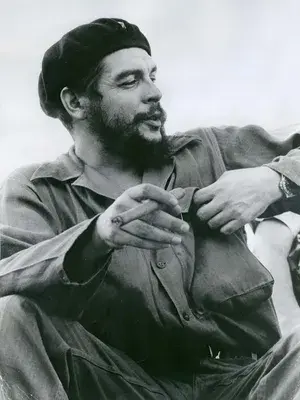
The picture above is of Ernesto "Che" Guevara who was a major Latin American revolutionary figure and close associate of Castro although he wasn't originally from Cuba.

Above is a picture of Fidel Castro in 1959 after he took power in Havana (Britannica)
The Bay of Pigs
Top Secret Operation 40, established in 1960 created a counterinsurgency and counterintelligence group consisting of CIA officers and anti-Castro exiles that became the basis for the force that would attempt to invade Cuba. One of its key purposes was to plan and carry out political assassinations although it was acknowledged that simply killing Castro would have little value by itself in that he would just be replaced by Raul Castro or Che Guevara The designation 40 came about because there were originally only 40 agents but that eventually expanded to 70. Although Cuba was the initial objective, the plan extended to other Latin American countries as deemed necessary in the future (11 p. 60). President Eisenhower approved the plan on March 17, 1960 while stressing the need for deniability. Future Watergate burglar Frank Sturgis said in a 1975 interview regarding political assassinations; “The assassination section, which I was a part of...would upon orders, naturally, assassinate either members of the military or the political parties of the foreign country that you were going to infiltrate, and if necessary some of your own members who were suspected of being foreign agents” (31) At the same time another CIA sponsored group referred to as Brigade 2506 was undergoing training in Guatemala consisting of a force of 1,400 Cuban exiles.
From this evolved the failed Bay of Pigs operation. Training of the exile troops in Guatemala had already begun by the late summer of 1960 (32 p. 275). Prior to the landing Operation 40 purged Brigade 2506 of anyone suspected of having any sort of left leaning or anti-Bautista beliefs under the orders of E. Howard Hunt (also of Watergate fame) and they were to be in charge of purging Castro supporters from liberated towns had the invasion succeeded (33). Kennedy eventually rejected the Trinidad Plan that called for an amphibious and airborne assault favoring a night landing without direct US military intervention (32 p. 293). The revised plan that Kennedy approved called for an April landing and Kennedy emphasized that he wouldn’t authorize direct the introduction of US ground troops even if the exile army faced defeat. The hope was that the initial invasion would prompt a spontaneous uprising against Castro that would also give the US plausible deniability as Eisenhower had initially desired (1 pp. 64-65). Kennedy insisted on a landing site on the side of the island that faced away from the United States again, giving support to the claim of deniability. A series of beaches on the Zapata Peninsula, along the Bay of Pigs on the southwest coast of Cuba was selected. (1 pp. 65-66)
The CIA’s covert-action chief, Richard Bissell agreed to this and added that there would be minimal need for air strikes and the Cubans on the Island would join the revolt (32 p. 296). When the invasion was launched on April 15, 1961 8 B-26 bombers carried out strikes against the Cuban Air Force that were only partially successful (32 p. 303). Security Adviser, McGeorge Bundy, told CIA deputy director General Charles P. Cabell that further strikes would not be initiated until a beachhead was established. Because this never happened, this decision effectively cancelled the airstrikes. The actual landing occurred on April 17 around daybreak and they were met with heavy fire from the Cuban Revolutionary Armed Forces immediately and ran out of ammunition when the Cuban Air Force bombed their supply ships (1 p. 66). The exile brigade was surrounded and surrendered on April 19/20 (32 pp. 319-22). The military and the CIA were extremely disappointed at Kennedy’s decision to accept defeat and the president came to see this as a sort of trap or setup to force him to escalate the conflict.

Map of Cuba and the invasion plan from the time period is shown to the right. point two is the actual Bay of Pigs location and this was the real name. (AP)

To the left is "Penitentiary Canal" which was the base for "counter revolutionary" activity during the Bay of Pigs invasion

To the left is the USS Houston supply ship after being hit and becoming disabled (Gety Images)
The image tot he right shows the Cuban exile force surrendering and being taken into custody (Getty Images)

Operation Mongoose and Northwoods
Following the very public failure of the Pay of Pigs in April of 1961 it probably would have seemed reasonable or prudent to simply back away but US military leaders collectively chose to go all in. In late 1961 Operation Mongoose planned an extensive campaign of terrorist acts against Cuban civilians carried out by the CIA in Cuba (34 pp. 26-29)(35 pp. 170-200) to be run out of JMWAVE which was a secret US government covert operations and intelligence gathering operation on the campus of the University of Miami (36). The goal of the program was to cause the Cuban government to divert resources to deal with the terrorist attacks and to introduce restrictions on the Cuban population that would lead to a popular revolt against Castro and ultimately regime change.(37 pp. 53-64) The Operation was led by USAF General Edward Lansdale and for the CIA, William King Harvey. The name was given at a White House meeting on November 4, 1961 and was authorized by President Kennedy on November 30, 1961. The plan reportedly included plans to assassinate Castro to be carried out by the Mob under the direction of the CIA. Operation Mongoose made little progress prior to the Cuban Missile Crisis in October of 1962.
In late 1961 and 62 Operation Northwoods was devised to influence US public opinion and world opinion and to get support from the Organization of American States (OAS) for an invasion of Cuba using a variety of false flag attacks on different targets (11 pp. 70-71). The plan was to conduct a false “Communist Cuban terror campaign in Florida and Washington, D.C.” that would include hijacking commercial airliners, bombing buildings and ships, and political assassinations generally aimed at the Cuban exile community. Some of the specific options under consideration included a staged shoot down of a US military aircraft, staged aircraft hijacking, sinking of boats of Cuban refugees in the Caribbean, blowing up a US ship, and orchestrating various acts of terrorism in a number of US cities. Joint Chief of Staff Chairman Lyman Lemnitzer signed off on the proposal and arranged for CIA operatives to carry out the faked terrorist attacks. Twelve proposals were identified in a February 2, 1962 memorandum written by Brigadier General William H Craig and submitted to Brigadier General Edward Lansdale entitled "Possible Actions to Provoke, Harass or Disrupt Cuba.," (11 p. 71) Lemnitzer presented the collection of plans to Secretary of Defense McNamara on March 13, 1962 and it was passed to Kennedy for his approval three days later. Kennedy rejected the plan and made clear that there was no chance the US military would at that point take military action against Cuba (11 pp. 71-72) . Following the presentation of the Northwoods plan, Lemnitzer was removed from his post a Joint Chiefs of Staff but became the Supreme Allied Commander of NATO in January of 1963.

The memorandum above was the Joint Chiefs of Staff approval for Operation Northwoods to conduct a variety of false flag attacks to generate support for an invasion of Cuba. The individual proposals each involved detailed plans are were separate but coordinated fake terrorist attacks. This plan was readily dismissed by JFK but it does demonstrate what sort of thinking was within the realms of normalcy within the military, State Department, and CIA.

Joint Chief of Staff Chairman Lyman Lemnitzer, pictured above, was the man responsible for pulling together Operation Northwoods and presenting it to the President. He was relieved of his position after that but shortly afterwards wound up as head of NATO

USAF General Edward Lansdale was the leader of Operation Mongoose to commit terrorist acts in Cuba to try to topple Castro and the was approved by Kennedy but didn't make much progress prior to the Cuban Missile Crisis.
The Cuban Missile Crisis
The next and most dangerous crisis was the Cuban Missile Crisis of October 1962. Khrushchev wrote in his memoirs “we were quite certain that the [Bay of Pigs] invasion was only the beginning and that the Americans would not let Cuba alone”[(38 p. 492). This led to the idea of installing nuclear weapons in Cuba and hiding them from the US until it was too late to do anything about it. The Soviet leader went on to say later, “The main thing was that the installation of our missiles in Cuba would, I thought, restrain the United States from precipitous military action against Castro’s government. In addition to protecting Cuba, our missiles would have equalized what the West likes to call ‘the balance of power.’ The Americans had surrounded our country with military bases and threatened us with nuclear weapons, and now they would learn just what it feels like to have enemy missiles pointing at you” (38 p. 494) This, however, showed a general lack of understanding of the American Cold War mindset that was nearly to prove catastrophic.
In July of 1962 the CIA identified an increase in the number of ships at Cuban ports along with earthworks and surface to air missiles. CIA director McCone suspected that the Soviets intended to go further and install medium range nuclear ballistic missiles. The following month the president authorized a U-2 over flight which was risky in that the Soviet anti-air missiles definitely had the capability to bring down the U-2 as was shown later. The mission produced low resolution images of major construction and machinery. Information provided by Oleg Penkovsky, a colonel in the GRU, Soviet military intelligence, who had agreed to spy for British intelligence and would be arrested and executed by the Soviet authorities the following year, helped to interpret the images. This confirmed the suspicions of McCone that they were in fact ballistic missile launch sites. (1 pp. 70-72) As the US became aware of construction in Cuba, the pressures on President Kennedy for a preemptive U.S. strike was intense (7 pp. 20-21) and assumed the launch sites were not yet operational. In another U-2 flight over Cuba on October 27th to evaluate progress the plane was shot down and the pilot (Rudolf Anderson) was killed. Kennedy secretly taped the White House meetings during the crisis and the tapes were declassified, transcribed, and published in the 1990’s (39). Kennedy was consistently almost alone in resisting war and maintaining his policy of a blockade.
Kennedy continued to pursue a diplomatic solution that bypassed typical diplomatic channels. Between 1961 and 63 there were twenty-one secret confidential letters between Kennedy and Khrushchev (40). Some of these were debates that didn’t really resolve anything but they did establish a path of direct communication that was direct and went around formal channels. On Friday night, October 26, Kennedy received a letter from Khrushchev where he offered to withdraw his missiles. In exchange, Kennedy would pledge not to invade Cuba which created some hope. However, the next morning, Kennedy received a second letter from Khrushchev adding to the terms. He demanded a U.S. commitment to remove missiles from Turkey and Russia would promise not to invade Turkey. This was reasonable in its symmetry but put Kennedy in a very difficult position of surrendering the defense of a member NATO state and he was on shaky ground already domestically. JFK sent a message via Robert Kennedy to Ambassador Anatoly Dobrynian to pass to Khrushchev offering to remove the missiles from Turkey but said it couldn’t be done immediately. Khrushchev accepted and this defused the situation. Kennedy’s promise was fulfilled six months later (7 pp. 23-29).
In evaluating the performance of the CIA they were correct in identifying the threat but had made a critical mistake in determining that the threat was not as yet functional and this didn’t come to light for some after the event. In 1992 according to an article in the Russian press that was based on an interview in which both Kennedy’s Secretary of Defense Robert McNamara and Fidel Castro participated in that has produced numerous similar accounts, unbeknownst to the US, Soviet forces in Cuba had possessed a total of 162 nuclear warheads that were operational and had been prepared to launch on October 26, the day before the U2 had been shot down over Cuba. McNamara wrote of this in his memoirs, “Clearly, there was a high risk that, in the face of a U.S. attack—which, as I have said, many in the U.S. government, military and civilian alike, were prepared to recommend to President Kennedy—the Soviet forces in Cuba would have decided to use their nuclear weapons rather than lose them. “We need not speculate about what would have happened in that event. We can predict the results with certainty . . . And where would it have ended? In utter disaster.” (41 p. 341)

Image to the right is of a U2 spy plane. These flew fast and high but were not able to escape Soviet missile systems.

Map of Soviet missile buildup in Cuba from 1962. This was intended as reprisal for deployment of NATO missiles surrounding Russia. (Britannica)

Image to the left is of a US Neptune patrol plane flying low over a Soviet freighter during the Cuban Missile Crisis
(Getty Images)
To the right is an image of the missile sites and related construction activity from the first U2 flyover (Wikipedia)


To the left is a photograph of the U2 shot down over Cuba that was shot down on October 27th. (Getty Images)
After Cuba
After the firing of Allen Dulles and the murder of President Kennedy the CIA continued to operate in the same manner. In September of 1964 CIA intervention (principally financial) in the Chilean presidential election helped to defeat Salvador Allende who was reputedly a communist. In December, working with the UK, the CIA whipped up racial conflict in British Guiana, which would soon be independent of England, in order to keep the nation’s founding father, Cheddi Jagan, out of office. Meanwhile Cuba had also been involved in aiding Jagan (1 pp. 66-67). In the climate of the time this might have seemed justifiable and even necessary but from the eyes of the rest of the world the Americans were on one hand preaching the virtues of democracy as if it was an end in itself but then subverting the outcome of democratic processes betraying their own principles. The collective effect of aggressive interventions across the globe damaged the image of the country and the agency and this eventually even started to get through to both prominent and ordinary Americans. After the Kennedy assassination Harry Truman wrote that he never intended the CIA to be a “cloak and dagger” operation and called for the CIA authority to be limited to intelligence gathering. (42)
A frequent explanation offered during the cold war era to explain the differences between the communist and “free world” was to explain that in the communist world “the end justifies the means” while, in America and the free west, we are constrained in our actions by morality regardless of the nobility of the objective. The phrase wasn’t actually attributable to Marx or Lenin but is credited to renaissance philosopher Niccolo Machiavelli. The actions of the CIA when exposed clearly prove this contention to be categorically false and further establish how far the US and western culture had drifted from its Christian origins. The US while claiming to be a Christian capitalist democracy had become a post-Christian, corporate capitalist, bureaucratic state largely run by unelected institutions with a thin veil of democratic processes.
In analyzing how the CIA developed during these formative years has led some to focus on cultural factors in the staffing of the agency and, although not proven or perhaps provable, this deserves some consideration. President Nixon complained about CIA officers being primarily drawn from the “Ivy League and the Georgetown set,” (1 p. 68). This refers to a general stereotype of someone who comes from a Northeastern Puritan background with “old money”, attends a prep school like Groton (“Grotonian”) followed by Ivy League colleges, and then becomes part of the Washington establishment in the upscale Georgetown area which is frequently referred to as the Washington Beltway (and is the root of the expression “beltway bandit”). Certainly this background is way overrepresented in the CIA as well as in other government functions especially amongst prominent individuals, but there are also those who come from other backgrounds but are assimilated into the culture. Simply looking at the background misses the real question. Cultures, though they may be based on an ethnic and frequently religious beginning typically provide paths for others to enter after they have shown themselves to have been conformed to that culture.
The highly concentrated military contractor base that developed during WWII largely around the War Production Board and was deeply embedded in the federal government became the core of what came to be referred to in the time as the “Power Elite”. This was recognized as far back as the mid 1940’s and addressed by numerous writers and commentators including James Burnham who co-founded National Review. He foresaw in his book the Managerial Revolution published at the beginning of WWII a global shift where private ownership and capitalism as it had existed would be replaced by collectivism and central planning. This in turn was a major influence and source for George Orwell’s writings including 1984 and Animal Farm.
Historically the most definitive work was The Power Elite published in 1956 and written by C. Wright Mills. Mills describes the power elite as consisting of the top executives of the largest corporations, military leaders, and the executive branch of the federal government which would include the federal agencies that would become largely out of the control of both the elected chief executive and the electorate. Mill’s book starts with the ominous observation:
“But not all men are in this sense ordinary. As the means of information and of power are centralized, some men come to occupy positions in American society from which they can look down upon, so to speak, and by their decisions mightily affect, the everyday worlds of ordinary men and women. They are not made by their jobs; they set up and break down jobs for thousands of others; they are not confined by simple family responsibilities; they can escape. They may live in many hotels and houses, but they are bound by no one community. They need not merely ‘meet the demands of the day and hour’; in some part, they create these demands, and cause others to meet them. Whether or not they profess their power, their technical and political experience of it far transcends that of the underlying population. What Jacob Burckhardt said of ‘great men,’ most Americans might well say of their elite: ‘They are all that we are not.(43 p. 303)’” C. Wright Mills (44 p. 3)
The Power Elite didn’t compromise a conspiracy in the sense the word is commonly understood. As Mills points out, “although men sometimes shape institutions, institutions always select and form men”. The few that would be promoted from the institutional infrastructure under the Power Elite would learn to fit in and conform and, most importantly, become useful for those above them which doesn’t necessarily simply correlate to performing their jobs well. They don’t all have the same views but they have the same self interests that are generally advanced by the same policies or actions making the herding behavior largely self organizing. Electoral politics are of little concern because the parties and elected officials are no longer making the larger strategic decisions.
Bibliography
1. Jeffreys-Jones, Rhodi. A Question of Standing: A history of the CIA. Oxford : Oxford Press, 2022.
2. Swanson, Michael. Why The Vietnam War? Nuclear Bombs and Nation Building in Southeast Asia, 1945-1961. New York : Campania Partners LLC, 2021.
3. Bradley, James. The China Mirage: The Hidden History of American Disaster in Asia. New York : Little, Brown and Company, 2015.
4. Hardley, David P. Rising Clamor. s.l. : University of Kentucky Press, 2019.
5. Fleming, Thomas. The New Dealers War. New York, New York : Basic Book, 2001.
6. Grose, Peter. Gentleman Spy; The Life of Allen Dulles. New York, New York : Houghton Miffin, 1994.
7. Douglas, James W. JFK and the Unspeakable. New York, New York : Simon & Schuster, 2008.
8. Hogan, Michael J. A Cross of Iron; Harry Truman and the Origins of the National Security State. New York, New York : Cambridge University Press, 1998.
9. Kennan, George. Telegram sent from American Embassy in Moscow 22 February, 1946. February 22, 1946.
10. Wise, David and Ross, Thomas. Invisible Government. New York : Random House, 1964.
11. Mennitti, Phil. The Illusion of Democracy: A More Accurate History of the Modern United States. 2017.
12. Constant, Alex. Mockingbird: The Subversion of the Free Press by the CIA. s.l. : Sheridan Square Press, 1991.
13. F. Frank Wyatt, CIA Officer, is Dead. New York Times. July 06, 2006.
14. Corke, Sarah-Jane. US Cold WAr Operations and Cold War Strategy; 1945-53. New York : Routledge, 2007.
15. Goda, Norman J.W. History News Network. [Online] February 8, 2010. https://historynewsnetwork.org/article/who-was-stepan-bandera.
16. Horton, Scott. Provoked: How Washington Started the New Cold War with Russia and the Catastrophe in Ukraine. Austin, Tx : Libertarian Institute, 2024.
17. The OAN, the UPA, and the Holocost. Rudling, Anders. 2011, Russian and East European Studies, p. 2107.
18. Kennedy, Joseph P. Present Policy is Politically and Morally Bankrupt. Vital Speeches. Jamnuary 1, 1951.
19. Kennedy, James Ronald and Kennedy, Walter Donald. Yankee Empire. Colombia, South Carolina : Shotwell Publishing, 2018.
20. Chalmers, Johnson. The Sorrows of Empire. New York, New York : Henry Holt & Co, 2004.
21. Ghazvinian, John. America and Iarn. s.l. : Knoph, 2021.
22. Perloff. The New American. [Online] May 12, 2009. https://thenewamerican.com/iran-and-the-shah-what-really-happened/.
23. Horton, Scott. Enough Already: Time to End the War on Terrorism. Austin, Texas : The Libertarian Institute, 2021.
24. Kendall, Willmore. Function of Intelligence. 1949.
25. Britannica - Cuban Revolution. [Online] 2024.
26. Morgan, William. A Rebel Americano in Cuba. 2012.
27. Farber, Samuel. Cuba Before the Revolution. Jacobin Magazine. September 6, 2015.
28. English, T.J. and Morrow, William. Havana Noctume: How the Mob Owned Cuba and the Lost it to the Revolution. 2008.
29. Kennedy, John F. Remarks at Democratic Dinner. Kennedy Library. October 6, 1960.
30. Kellner, Douglas. World L Eaders Past and Present. s.l. : Chelsea House, 1989.
31. Marshall, Jonathan. A New Watergate Revelation: The While house Death Squad. Enquiry. March 5, 1979, p. 18.
32. Kornbluh, Peter. The Bay of Pigs; A Comprehensive Chronology of Events. New York, New York : New Press, 1998.
33. Schlesinger, Arthur Jr. Memorandum for Mr. Richard Goodwin Document 0355 - Cuban Information Archives. June 9, 1961.
34. Erlich, Reese. Dateline Havana: The Real Story of US policy and the future of Cuba. New York : Routledge, 2008.
35. Schoultz, Lars. That Infernal Little Cuban Republic: The United States and the Cuban Revolution. Chapel Hill, NC : University of North Carolina Press, 2009.
36. Hach, Stever. Cold War in South Florida. Washington DC : US Department of Interior, 2004.
37. Bolender, Keith. Cuba Under Seige: American Policy, the Revolution, and its People. New York : MacMillan, 2012.
38. Khruschev, Nikita. Khruschev Remembers. Boston : Little Brown, 1970.
39. May, Ernest R and Zelikow, Phillip D. The Kennedy Tapes. Cambridge, Mass : Harvard University Press, 1997.
40. Wells, Paul. Private Leters Shed Light on Cold War. Montreal Gazette. July 24, 1993.
41. McMamara, Robert S. In Retrospect. New York, New York : Random House, 1955.
42. Truman, Harry S. Truman Deplores Change in CIA Role. Evansville Courier. December 21, 1963.
43. Burckhardt, James. Force and Freedom. New York : Pantheon Books, 1943.
44. Mills, C. Wright. The Power Elite. New York : Oxford University Press, 1956.