Dyed-In-The-Wool History

Origins of the Cold War 1944-1950
Jim Pederson December 28, 2024
The Cold War is generally seen as starting after WWII and is probably most commonly associated with George Keenan’s “Long Telegram” and a gradual shift in intellectual alignment towards a centrist corporate liberalism but the events that led to and enabled the Cold War are traceable to the later phases of WWII. Specifically without the events that economically enabled the Cold War it couldn’t have developed as it did regardless of philosophical shifts or arguments and these enabling factors have largely defined the economic changes after the war extending to the current time period. The War State: The Cold War Origins of the Military Industrial Complex and the Power Elite by Michael Swanson and The Wise Men by Walter Isaacson and Evan Thomas are major sources for this post / essay
Beginning of the Military Industrial Complex
Supplying the military with the tools of war and providing armies with food and other items necessary to support a force in the field has always been a profitable endeavor and as the armies and navies got larger and the equipment more complex and expensive the business opportunities expanded. The American Civil War (War Between the States) provided vast business opportunities and produced the beginnings of the Rockefeller financial dynasty when John D Rockefeller and two business associates were logistics contractors for the Union Army. The profits from this venture were parlayed into the beginnings of Standard Oil. In his short antiwar classic Marine Corp General Smedley Butler claimed that WWI produced 21,000 millionaires writing "In the World War a mere handful garnered the profits of the conflict. At least 21,000 new millionaires and billionaires were made in the United States during the World War. That many admitted their huge blood gains in their income tax returns. How many other war millionaires falsified their tax returns no one knows." War profits through WWI were broadly distributed amongst a large number of smaller contractors or suppliers with individual suppliers not having a great deal of political influence but that was to change.
WWII brought about fundamental changes in military contracting that changed the military and the government from that time forward. The Roosevelt administration integrated app. Ten thousand business executives into staff positions throughout the federal agencies with these positions being created by executive fiat (1 p. 16). In 1942 the War Production Board was created that had broad power to direct the economy for the rest of the war including the power to prohibit production that wasn’t deemed essential to the war effort. The board controlled the allocation and management of war related contracts and the assignment of contracts aligning closely with the companies that the board members had relationships with. The scale of the contracts in comparison to previous eras was huge and 74% were awarded as the result of negotiations without competitive bidding (1 p. 17). Board Member and President of General Electric stated, “This defense program is big business…. we might just as well make up our minds to that. It is big business and it isn’t going to be handled by thousands of small businesses alone. Small plants can’t make tanks, airplanes, or other large complex armaments.” (2 pp. 80-1)
The systems and platforms weren’t simply complex manufacturing efforts but also involved cutting edge engineering and large technical staffs. Much of the infrastructure required didn’t already exist as the aerospace manufacturers in particular during this time tended to be smaller operations. The federal government frequently acquired the land and built the factories then gave them to the suppliers after the war. Of twenty-six billion spent on defense plants during the war, seventeen billion was financed by the government (1 p. 18). The defense industry was built by American taxpayers and from that, many dual use products were spun off. By 1941 75% of defense spending went to only 56 companies with a third of those contracts going to six companies which were led by Bethlehem Steel, General Motors, and Du Pont. As time passed the contractor base would grow numerically smaller and economically larger (1 p. 19). Many contracts were cost plus, which was justified based on uncertainties of new development, but the effect of this was a form of corporate socialism where the capital was provided by the government, the risk was borne by the taxpayer, and the profits accrued to the supplier.
In all previous wars the military demobilized after the war but as WWII entered its final months, the American defense industry determined that they did not want the nation to demobilize, for obvious reasons, and lobbied for the nation to be set on a permanent war economy. This would need a way to pay for it, which would require reallocation from consumer products or endless deficits, and justification that the public would accept and both these things were taking shape at the time. Charles Wilson (head of General Electric) argued that the country’s security now required the ability to go to full war at a moment’s notice. “What is more natural and logical … than that we should henceforth mount our national policy upon the solid fact of an industrial capacity for war, and a research capacity for war that is also ‘in being’? It seems to me anything less is foolhardy.” Wilson saw the need for the industry to band together to fend off “political witch hunts” or to be accused of being “merchants of death.” (1 pp. 23-4).
It should be emphasized here that, as with any other perceived problem that is addressed by a permanent government of government/industry institution, the problem itself which may have been temporary or intermittent tends to become permanent. If those given the charter and the funding to address the problem were to ever resolve it their protective and redemptive services would no longer be required. The economic motivation therefore, is to ensure that the problem being addressed is perceived as consistently getting worse and requiring more money to address. If questions arise as to why previous funding increases apparently weren’t effective the public is to believe that the problem without government action would have been that much worse. This had been seen with social programs that were created during the progressive era (largely in the Wilson administration) and now the same pattern was to apply to the military. The economic motivation for what was to become the “military industrial complex” would not be to avoid wars and, when forced to fight, resolve the matter quickly, but would rather be to ensure there are always an expanding number of active threats which require ever increasing budgets to manage. In 1948 historian Charles Beard addressing the dangers to constitutional government that the flow of power into the executive branch and the government agencies pose wrote:
“The further away from its base on the American continent the government of the United States seeks to exert power over the affairs and relations of other countries the weaker its efficiency becomes,” he wrote, “and the further it oversteps the limits of its strength the more likely it is to lead the nation into disaster—a terrible defeat in a war in Europe or Asia beyond the conquering power of its soldiers, sailors, and airmen. If wrecks of overextended empires scattered through the centuries offer any instruction to the living present, it is that a quest for absolute power not only corrupts, but in time destroys.” Charles Beard (3 pp. 592-3)
This link is to a War Production Board video from 1944 on the need for scrap metal from Periscope Film
The Power Elite
The highly concentrated military contractor base that was deeply embedded in the federal government became the core of what came to be referred in the time as the “Power Elite”. This was recognized as far back as the mid 1940’s and addressed by numerous writers and commentators including James Burnham who co-founded National Review. He foresaw in his book the Managerial Revolution published at the beginning of WWII a global shift where private ownership and capitalism as it had existed would be replaced by collectivism and central planning. He observed that managerial elites had taken control of corporations, government bureaucracies, and the military and would ultimately take over society (1 p. 25). He argued that this was fundamentally what had occurred in Soviet Russia and Nazi Germany and was happening in America in the developing corporate liberalism. He also saw the world being divided into a limited number of “super states” after the war, reasoning that this was inevitable in order for the modern economy to function. Burnham’s book was a big seller and a major influence on George Orwell when he wrote 1984. Burnham was correct in many respects but over-emphasized forms of organization as opposed to who controlled them which extends beyond the managerial class to the sponsors. (1 p. 25)
Historically the most definitive work was The Power Elite published in 1956 and written by C. Wright Mills. Mills describes the power elite as consisting of the top executives of the largest corporations, military leaders, and the executive branch of the federal government which would include the federal agencies that would become largely out of the control of both the elected chief executive and the electorate. Mill's book starts with the ominous observation:
“But not all men are in this sense ordinary. As the means of information and of power are centralized, some men come to occupy positions in American society from which they can look down upon, so to speak, and by their decisions mightily affect, the everyday worlds of ordinary men and women. They are not made by their jobs; they set up and break down jobs for thousands of others; they are not confined by simple family responsibilities; they can escape. They may live in many hotels and houses, but they are bound by no one community. They need not merely ‘meet the demands of the day and hour’; in some part, they create these demands, and cause others to meet them. Whether or not they profess their power, their technical and political experience of it far transcends that of the underlying population. What Jacob Burckhardt said of ‘great men,’ most Americans might well say of their elite: ‘They are all that we are not. (4 p. 303)’” C. Wright Mills (5 p. 3)
These entities would create a “permanent war economy and a private corporation economy” (5 p. 275). Mills observed that “the economy has become dominated by two to three hundred giant corporations, administratively and politically integrated, which together hold the keys to economic decisions” and that the perception of American history as “a peaceful continuum of peace interrupted by war” (5 p. 184) as being permanently eclipsed. Mills described the social structure of the Power Elite saying:
They form a more or less compact social and psychological entity; they have become self-conscious members of a social class. People are either accepted into this class or they are not, and there is a qualitative split, rather than merely a numerical scale, separating them from those who are not elite. They are more or less aware of themselves as a social class and they behave toward one another differently from the way they do toward members of other classes. They accept one another, understand one another, marry one another, tend to work and to think if not together at least alike. (5 p. 11)
The Power Elite don’t compromise a conspiracy in the sense the word is commonly understood. As Mills points out, “although men sometimes shape institutions, institutions always select and form men”. The few that would be promoted from the institutional infrastructure under the Power Elite would learn to fit in and conform and, most importantly, become useful for those above them which doesn’t necessarily simply correlate to performing their jobs well. They don’t all have the same views but they have the same self interests that are generally advanced by the same policies or actions making the herding behavior largely self organizing. Electoral politics are of little concern because the parties and elected officials are no longer making the larger strategic decisions. Elected officials are part of a middle layer that Mills goes on to describe:
“The power elite are not solitary rulers. Advisers and consultants, spokesmen and opinion-makers are often the captains of their higher thought and decision. Immediately below the elite are the professional politicians of the middle levels of power, in the Congress and in the pressure groups, as well as among the new and old upper classes of town and city and region. Mingling with them, in curious ways which we shall explore, are those professional celebrities who live by being continually displayed but are never, so long as they remain celebrities, displayed enough. If such celebrities are not at the head of any dominating hierarchy, they do often have the power to distract the attention of the public or afford sensations to the masses, or, more directly, to gain the ear of those who do occupy positions of direct power. More or less unattached, as critics of morality and technicians of power, as spokesmen of God and creators of mass sensibility, such celebrities and consultants are part of the immediate scene in which the drama of the elite is enacted. But that drama itself is centered in the command posts of the major institutional hierarchies. (5 p. 4)
The Power Elite were to become ingrained in the structure of not just the economy but society in a broader sense. The institutions would disperse themselves geographically and the towns and cities they would populate would become dependent on them creating broad political support. Specifically in the case of military contracting this is done by having plants in multiple states and further spreading the subcontractor base. Although the model of the Power Elite was built around the military industrial complex it would rapidly expand to any industry that was or could be made dependent on the government, the more prominent examples of which include the medical and pharmaceutical industry, education, and media.
Mill’s book followed Burnham’s work nearly 15 years and he had more of a chance to see the post war structure develop but it was remarkably accurate in its assessment and prophetic in terms of foreseeing what was to follow. Michael Swanson summarized the importance of the classic and largely forgotten work saying:
Have you ever heard of it? If you haven’t, then you need to know about it, and if you already have, then you need to make sure you have a good grasp of its arguments in order to get a better understanding of how the real big decisions are truly made in this country when it comes to war, Wall Street bailouts, national security issues, and even the interest-rate policies that impacts your day-to-day life when it comes to things such as the price of oil, housing prices, and even the unemployment rate. These types of issues are not voted upon by Congress, hardly debated about in elections, and even more rarely decided upon by voters. The final decisions are made by a power elite, whose activities are barely understood by most but whose workings will be fully comprehended by you as you read this book. (1 pp. 27-8)
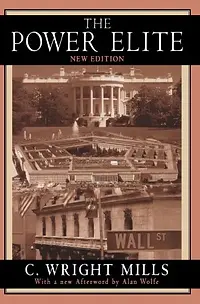
This is the cover of the Power Elite which is a historically significant book by Professor C. Wright Mills from 1956 that describes social changes associated with the way power was held coming out of WWII. Mills was a professor at Colombia when he died at the young age of 46. He was originally from Waco, Texas.
United Nations and Bretton Woods
Roosevelt’s post war international vision consisted of a strengthened version of the League of Nation’s that would be hosted in New York with other nations invited to it and a financial structure to protect free trade and sound money. What exactly is meant by free trade and sound money can be argued and we will come back to that question. The new United Nations would have a security council made up of the most powerful nations that would have the ability to create collective security pacts, make joint declarations of war, and have individual veto power. Speaking to Henry Wallace in 1942 he said “When there are four people sitting in a poker game and three of them are against the fourth it is a little hard on the fourth.” (1 p. 47) He explained this concept to Soviet Minister of Foreign Affairs Molotov saying, “it would be necessary to create an international police force” to prevent new wars and that Germany and its satellites would have to be disarmed while the victors were to remain armed together after the war.” Stalin told Molotov to convey to Roosevelt that he was “absolutely correct”. (6 pp. 33-7)
The financial infrastructure to support the internationalist vision was addressed at the Bretton Woods conference at Bretton Woods New Hampshire in July of 1944 which was also referred to as the United Nations Monetary and Financial Conference that had 44 allied nations present. In addition to creating the International Monetary Fund and the World Bank, the principal outcome of the conference was that the dollar would be pegged to the price of gold and would be the reserve currency for central banks across the world giving the US a permanent advantage in global monetary markets so long as the system remained in place (1 p. 48). (7 pp. 98-100) This system was essential the same as the gold exchange standard the British tried to put in place after WWI that was intended to maintain the value of their currency at a pre-WWI level which was no longer supported by the free market. The British scheme eventually collapsed and efforts by the Morgan controlled US central bank to support the British in this endeavor caused rapid US currency expansion which was a major factor in triggering the depression (7 pp. 93-6). The dollar would be valued at 1/35 of a gold ounce and would be “the only” key currency. The 1920’s valuation plan allowed for multiple “key currencies” and the dollar would no longer be redeemable to American citizens but only foreign government central banks. The US could pyramid dollars in paper money and bank deposits on top of gold and the US had vast gold reserves at the end of the war (app. $25billion) (7 pp. 98-100). The world’s currencies were to return at their pre-WWII pars which were generally highly overvalued as their currencies had depreciated while the dollar was undervalued (7 pp. 98-100)
Looking ahead at how this would eventually play out, the relative valuation initially created a dollar shortage in terms of balance of payment which was made up for by US foreign aid (7 pp. 100-2). The initial valuations and US gold reserves allowed ample room to inflate the dollar for a number of years but by the mid-1950’s US inflation began to create trade deficits. While the US was still inflating their currencies, most European countries, which were frequently influenced by “Austrian” or libertarian monetary policy, pursued more hard money policies (7 pp. 100-2). The exception to this was Britain which was still inflating and devaluing their currency. This US inflationary practices didn’t abate but worsened through the 1950’s and 1960’s creating a political and economic conflict between the US and hard money countries most associated the France’s De Gaulle and his primary economic advisor Jacques Rueff (7 pp. 100-2). The hard money countries did have an option for redeeming the dollar at $35 an ounce which they opted for causing an outflow of gold from the US until the system unwound between 1968 and 1971 and was eventually replaced with the petro-dollar which was another way to create artificial demand for a weak currency.
The structure and outcome of Bretton Woods is definitive but what FDR’s intentions were and how we got to the final structure of the post war financial system remains a subject of controversy. Some would see FDR’s talk of free trade and anti-imperialism as simply dressing the real objective of post war US economic and monetary dominance in moral garb and making practical objectives appear to be moral or even religious ventures as has been common throughout American political history. Others see this as a sincere objective. Based on statements he made, FDR was definitely interested in protecting what he saw as America’s national interests but he also indicated he wanted to create a more fair economic system that protected the interests of developing countries with weak currencies that would allow them to develop without having their assets stripped in the process. This is best preserved by his son Elliott Roosevelt who recorded his father’s thoughts and correspondence in a book titled As He Saw It that was written in 1946 prior to the Cold War being fully put in motion. The following account of a conflict between FDR and Churchill during the Casablanca Conference is indicative of the content of the book:
“Of course,” he [FDR] remarked, with a sly sort of assurance, “of course, after the war, one of the preconditions of any lasting peace will have to be the greatest possible freedom of trade.”
He paused. The P.M.’s head was lowered; he was watching Father steadily, from under one eyebrow.
“No artificial barriers,” Father pursued. “As few favored economic agreements as possible. Opportunities for expansion. Markets open for healthy competition.” His eye wandered innocently around the room.
Churchill shifted in his armchair. “The British Empire trade agreements” he began heavily, “are—”
Father broke in. “Yes. Those Empire trade agreements are a case in point. It’s because of them that the people of India and Africa, of all the colonial Near East and Far East, are still as backward as they are.”
Churchill’s neck reddened and he crouched forward. “Mr. President, England does not propose for a moment to lose its favored position among the British Dominions. The trade that has made England great shall continue, and under conditions prescribed by England’s ministers.”
“You see,” said Father slowly, “it is along in here somewhere that there is likely to be some disagreement between you, Winston, and me.
“I am firmly of the belief that if we are to arrive at a stable peace it must involve the development of backward countries. Backward peoples. How can this be done? It can’t be done, obviously, by eighteenth-century methods. Now—”
“Who’s talking eighteenth-century methods?”
“Whichever of your ministers recommends a policy which takes wealth in raw materials out of a colonial country, but which returns nothing to the people of that country in consideration. Twentieth-century methods involve bringing industry to these colonies. Twentieth-century methods include increasing the wealth of a people by increasing their standard of living, by educating them, by bringing them sanitation—by making sure that they get a return for the raw wealth of their community.”
Around the room, all of us were leaning forward attentively. Hopkins was grinning. Commander Thompson, Churchill’s aide, was looking glum and alarmed. The P.M. himself was beginning to look apoplectic. (8)
The valuation scheme was defined mathematically and tilted the playing field very strongly towards the US. In terms of intent all that could potentially be said to mitigate that would be to contend that the Roosevelt administration didn’t intend to abuse this monetary advantage but that, of course, wasn’t to be. Without this, the US wouldn’t have been able to create ever larger deficits that were needed to finance the Cold War. The arguments involving the IMF, World Bank, and Bank of International Settlements however may tell another story and this revolves around Harry Dexter White who is most remembered in history as having been exposed as a Soviet agent / sympathizer after the war. Had history developed differently, that might not be the case and the matter is still open to dispute. He was accused of being a spy in 1948 by the House Committee on Un-American Activities and vigorously denied the charges when called to testify. He died of a heart attack a few days after his testimony. That aside he was a leading thinker in Henry Morgenthau’s Treasury Department and was “arguably the most important U.S. government economist of the 20th century.” (9 p. 177)
White was born in Boston in 1892 to Jewish Lithuanian immigrants and served in the US military in WWI. He began his college studies at age 29 and completed his doctorate at age 40. At the time of Bretton Woods he was 55 years old and not well known to the general public while having played a major role in the New Deal. He was the force behind the creation of the IMF and the World Bank and worked with British economist John Maynard Keynes in creating the post war financial structure. White had shown himself to be politically savvy and in understanding the objectives of the Roosevelt administration at Bretton Woods and was a key player (9 p. 177). Also present at Bretton Woods was State Department Official Eleanor Lansing Dulles, sister of John and Allen Dulles.
White spoke of the new financial structure as a “New Deal for a new world,” with the new global institutions channeling investment to needy countries in ways that produced the broadest public good rather than the greatest private gain.” (9 pp. 177-8) White’s boss, Secretary Morgenthau, declared the goal of the IMF and World Bank was “to drive . . . the usurious money lenders from the temple of international finance.” (9 pp. 177-8) At the conference Morgenthau and White led a movement to abolish the Bank for International Settlements (BIS), which was established in 1930 realizing Montagu Norman long standing goal of establishing collaboration between central banks (10 p. 276). This was seen by White as a tool for maintaining financial dominance of the European and American financial elite. It took a major, behind-the-scenes campaign at Bretton Woods orchestrated by representatives of Wall Street, the State Department, and the Bank of England to preserve the BIS (9 pp. 177-8). The Morgenthau-White plan was to replace the BIS with the World Bank and the International Monetary Fund. White further envisioned, as FDR did also, a post-war partnership with the Soviet Union promoting world peace and the opening of Soviet markets to US producers. (9 p. 178)
So the new international order the US was forming after the war was torn in two different directions by competing factions that were both within the Roosevelt administration. The Rockefeller aligned faction that was linked to the “Wise Men” sought US global dominance while the “New Dealers” looked to form a world community. They were both globalist and would lead the country against the prevailing isolationism that took root after WWI. This sort of internationalist vision had a long history in American politics that was largely cultural being associated with Puritan or Yankee culture but was not generally supported otherwise. The constituency that shared this vision, however, was powerful and helped advance FDR’s objectives in American domestic politics (1 p. 48).
Those most inclined to support internationalism were, not surprisingly, those who would economically benefit most from it but there were also cultural patterns. The major beneficiaries of the coming globalism were American and international bankers who create and loan money to nations and facilitate international trade. Next would be large multinational corporations with global markets that can leverage vertical integration and don’t have to compete with third world labor costs (1 pp. 48-9). International oil companies and technology companies, which at the time specifically referred to IBM, were very receptive to globalism or internationalism. On the other end of the spectrum were companies that relied on a national market and whose largest costs were wages and wage related expenses. Textile companies were a prime example of this (1 pp. 48-50). The textile industry originated in the North at the beginning of the industrial revolution then moved to the South frequently with entire towns being built around the textile mill and these specifically had their fate sealed. The biggest losers in all of this would, of course, be American labor – those citizens who rely on what they produce to survive as opposed to returns of capital. It should be noted here that labor costs frequently are as much a factor of currency valuation as inherent economic factors and the artificially high exchange rate of the dollar coupled consistent inflation made the eventual erosion of the American working class all but certain. The outcome of all of this would take some time to realize as America would have to inflate its currency and eradicate the economic advantages it emerged with at the end of the war. Other countries that had little or no manufacturing capability would also take time to develop. While this was obvious to only a few, the path was set and wouldn’t be, and perhaps couldn’t be, altered.
Roosevelt was without a question an internationalist with some progressive visionary tendencies but his relationship with business and financial interests was not always that of an adversary. His presidency was made possible by some of the largest corporations in America supporting him (1 p. 48) (11). In Roosevelt’s initial campaign he did attack the “money changers” and elite bankers but this criticism wasn’t universal. It was specifically targeted those associated with JP Morgan especially with regard to the Federal Reserve which they controlled during the 1920’s following the death of Warren Harding and his Vice President Coolidge coming to power (7). Roosevelt understood that the Fed’s mismanagement of money supply and interest rates caused the Great Depression and that the close ties between the Morgan controlled Federal Reserve and the Bank of England largely brought this about in order to support the British gold value scheme in the 1920’s (10).
Roosevelt was supported by the Rockefeller family which is historically interesting in that the Rockefeller dynasty had been consistently associated with the Republican Party. FDR’s cousin Theodore Roosevelt was a progressive Republican and was the first Republican linked to the House of Morgan after the Morgan’s abandoned the Democrats when William Jennings Bryan won the Democratic nomination (7). Teddy Roosevelt was also an extreme Anglophile while the Rockefellers were somewhat more inclined to align with Germany. Prior to FDR the Morgan’s dominated the previous two Republican administrations. The Rockefellers owned Chase Bank, Standard Oil, and had a large interest in Royal Dutch Shell and contributed vast sums to FDR’s campaign. (1 p. 50)
Roosevelt’s rise to power was largely brought about by a split in the financial elite following the beginning of the Depression. Quoting Michael Swanson with reference to Murray Rothbard:
Frank Vanderclip, the former president of National City Bank of New York, and James Rand of Remington Rand Company formed the Committee for the Nation to promote Roosevelt’s inflationary monetary policies. General Robert Wood of Sears, Roebuck & Co. and Magnus Alexander of the National Industrial Board joined it, along with other executives of some of the nation’s largest corporations. Roosevelt came into power thanks to a split within the power elite on the heels of the Great Depression. (1 pp. 50-1) (12)
The finance sector was overwhelming made up of Anglophiles and their most important lobbying group was then, and remains today, the Council of Foreign Relations and their quarterly publication, Foreign Affairs, was their journal of record. Liberal intellectuals were also drawn to Roosevelt’s internationalism with its ideals of international law, collective security, and global institutions. Meanwhile those who would be hurt by Internationalism or Globalism who were in the workforce at the time had no idea what was being done to them and most of the victims were nameless having not been born yet.
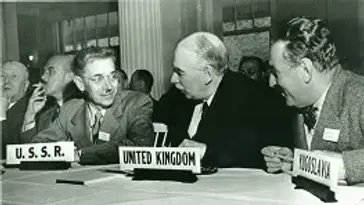
This is a picture of the Soviet and British representatives at Bretton Woods from the Getty collection. There were representatives of 44 nations present and the outcome would establish the dollar as the sole world reserve currency.
Near left is a picture of Harry Dexter White who was the chief US architect of the Bretton Woods financial structure. White is most remembered as a Soviet spy or sympathizer from the McCarthy era. Testifying before the House Committee on Un-American activity in 1948 he denied his guilt then died of a heart attack a few days later. The matter is still debated today. (Getty Collection)
Far Left is British Economist John Maynard Keynes who was a major architect of Bretton Woods.

Truman Takes Over
The potential for the Cold War was foreseeable at the end of WWII in no small part by the political power of those who would benefit from it. Avoiding this proved to be largely dependent on the personal relationships of the key allied leaders. Author Frank Costigliola devoted an entire book to developing this theme titled Roosevelt’s Lost Alliances: How Personal Politics Helped Start the Cold War in which he explores the background and life experiences of the national leaders and some other key players along with the respective cultures. He summarizes this in the introduction to his book pointing out that Roosevelt was doing all he could to preserve his health and extend his life until his post war vision could be established:
The Cold War was not inevitable. Nor did that conflict stem solely from political disputes and the ideological clash between capitalism and communism. Examining how the Grand Alliance operated and then fell apart is prerequisite for understanding how the Cold War formed. The alliance cohered and then collapsed for reasons more contingent, emotional, and cultural than historians have heretofore recognized. If Roosevelt had lived a while longer—indeed, he was trying to manage his health in order to survive—he might have succeeded in bringing about the transition to a postwar world managed by the Big Three. His death and Churchill's electoral defeat three months later disrupted personal and political connections in which all three leaders had invested enormous effort and cautious hope. Neither the men who succeeded these giants, nor the American “Soviet experts” who asserted a more decisive role than they had hitherto been allowed to play, shared Roosevelt's, or even Churchill's, interest in Big Three accord. (13 p. 4)
Truman was selected as VP in the previous election because Henry Wallace was perceived as being too far to the left and a political liability for Roosevelt (14). As VP, however, Truman had no real role in the administration and was not involved in any decisions. President Roosevelt hadn’t involved him in policy decisions or attempted to transfer knowledge to him so he knew very little for someone stepping to such a role after FDR’s death. He would need help and he knew it and sought out who he would listen to (1 p. 58). When FDR died on April 12, 1945 the key administration players which were most notable consisted of the Rockefeller aligned intellectual entourage referred to as the “Wise Men” that sought to shape the new president’s thoughts and actions to reflect their own which had been increasingly in conflict with Roosevelt and the New Dealer elements in the administration. The Wise Men which referred to William Averell Harriman, Robert Lovett, Dean Acheson, John Jay McCloy Jr., George Keenan, and Charles Bohlen were poised to become the “Architects of the American Century”. (15 p. 17)
Roosevelt had last met with Stalin from February 4th to 11th in Yalta, Crimea at which time post war “spheres of influences” were established and the Soviets agreed to enter the war against Japan three months after the surrender of Germany which would also pave the way for Russian participation in the post war occupation of Japan. In exchange for this, the allies agreed to recognize the provisional government Stalin had installed in Poland pending elections and the Soviet Union was to acquire land from Poland’s WWI boundaries and Poland would, in turn, take land from Germany. (1 pp. 55-6)
As the Russians learned of FDR’s death on April 12th there was a keen awareness that this event could alter the direction of history. When Molotov signed the condolences book at the American Embassy in Moscow he appeared to be “deeply moved and disturbed” (1 p. 58) A few weeks later, the head of the Soviet intelligence station in New York warned “economic circles” which had largely been ignored by Roosevelt were undertaking “an organized effort to bring about a change in the policy of the United States toward the USSR.” He referred to these influencers as “reactionaries,” which was a term that stuck but would develop various other shades of meaning, and observed they, “are setting particular hopes on the possibility of getting direction of the United States’ foreign policy wholly into their hands, partly because Truman is notoriously untried and ill-informed on these matters.” (1 p. 57)32 In this assessment he was not just generally correct but was precisely accurate.
In Moscow, Ambassador Averell Harriman had grown increasingly opposed to Roosevelt’s policies towards the Soviets. Molotov was to meet with Truman and Harriman was determined to get to Truman before that happened. On April 18th he set out on what diplomat Robert Meiklrjohn called an “around the clock race”. After overcoming initial reluctance on the part of the State Department he departed at 5AM flying westward in his private plane and arrived in Washington 49 hours later which was remarkable for the time. Flying eastward and not flying at night Molotov took days longer arriving at the White House on April 23rd (13 p. 312) (15 pp. 18-9).
Truman’s first act after being sworn in was to call a meeting with FDR’s cabinet where he told them that he was intending to carry on his policies and extended an offer of open communication if anyone had concerns they would like to discuss. Henry Stimson stayed after the meeting and told Truman of the development of the atomic bomb that he previously had no knowledge of (16 p. 9). Truman then spent most of the next two days meeting with Stimson and James Byrnes whose political stock was about to rise dramatically. Byrnes had been a senator from North Carolina from 1931 to 1941 and was then picked by FDR to be a Supreme Court Justice. He then left the Court and FDR appointed him head of the Office of War Mobilization which effectively made him head of the military industrial complex and one of the most powerful men in the country (1 pp. 58-9) Byrnes and Truman had a long history going back to when each was in Congress. He remained one of Truman’s closest advisors on foreign affairs and was appointed Secretary of State in July of 1945 (1 p. 59). When FDR replaced Henry Wallace with Truman as his Vice Presidential running mate in 1944 Byrnes was also considered.
Truman was scheduled to meet with Stalin and Churchill in Potsdam, Germany (16 p. 38) but Barnes convinced Truman to delay the meeting until the atomic bomb was tested. He saw that the bomb along with America’s economic strength coming out of the war would place the US in a dominant position stating, “The bomb might put us in a position to dictate our own terms at the end of the war” (1 p. 59). When Harriman met with Truman prior to Truman seeing Molotov, Harriman warned the Stalin was trying to create an area of influence in Eastern Europe. This was true but it was also something generally, and perhaps vaguely, agreed to at Yalta so this was not so much a warning as a protest of the position previously agreed to by FDR. The next day Truman met with Molotov and told him the he expected the Russians to follow all of the provisions of the Yalta conference including democratic elections throughout Eastern Europe. Then, specifically addressing Poland, Truman said that if the Russians didn’t let more people into the government the US would consider Yalta to be over stating that he wanted friendship with Stalin but that it wasn’t “a one way street”. Molotov relied “I have never been talked to like that in my life” to which Truman then said “Carry out your agreements and you won’t get talked to like that” (1 p. 61). Molotov stormed out of the room while Truman boasted to his advisors of his forceful communication to the Russian diplomat. Stalin responded back with a note stating, “it is also necessary to take into account the fact that Poland borders on the Soviet Union, which cannot be said of Great Britain and the United States. The question of Poland has the same meaning for the security of the Soviet Union as the question of Belgium and Greece for the security of Great Britain.” (16 pp. 77-85)
After that relations between Truman and the Stalin and Molotov started to thaw a bit. The Potsdam meeting went reasonably well but there was no agreement on Eastern Europe. Truman insisted that the US would only recognize governments created with a democratic political system and the matter was referred to the foreign ministers for further study (16 pp. 198-203). The idea of security zones was either not understandable to the Americans or simply not accepted in terms of future planning. During the conference Truman received a report that the test of the Atomic bomb was not only successful but that the explosion was even bigger than anticipated.

These are images from the Potsdam Conference that show Truman with Stalin and Churchill, The was Truman's first appearance on the "World Stage" (Getty Images)


The Russian Alliance Starts to Unravel
As the Atomic bomb was being developed the US shared some knowledge of the developing technology with Great Britain but the other major ally, Russia, was kept entirely in the dark. As the result of an effective intelligence program, aka spying, the Russians were well aware of the program anyway and were working on their own atomic bomb which the Americans were unaware of. After the initial use of the bomb, Secretary of War Henry Stimson, who was in charge of its development, sent a memorandum to Truman stating “in a world atmosphere already sensitive to power, the introduction of this weapon has profoundly affected political considerations in all sections of the globe.” He then went on to add that it was not just a new weapon, “but a first step in a new control of man over the forces of nature too revolutionary and dangerous to fit into the old concepts.” (1 p. 41) Stimson attempted to get Truman to propose to the British and Russians that “we would stop work on the further improvement in, or manufacture of, the bomb as a military weapon, provided the Russians and the British would agree to do likewise. It might also provide that we would be willing to impound what bombs we now have in the United States provided the Russians and the British would agree with us that in no event will they or we use a bomb as an instrument of war unless all three governments agree to that use.” (1 pp. 41-2) Stimson believed that if Truman didn’t create a mechanism for international control of the atomic bomb, a nuclear arms race would ensue that that could destroy the world but his advice was ignored.
The decision to use the bomb rested with Truman. He was left with the responsibility of implementing the final act of Roosevelt’s policy of unconditional surrender that very few world leaders, American military leaders, and even members of his own administration agreed with and which probably extended the war by over a year (14). After the war Truman justified his decision saying the deployment of the two atomic bombs “saved millions of lives” but even in the context of unconditional surrender it was far from certain if this contention was true. Herbert Hoover argued that Japan was already defeated and would have surrendered anyway. A month after the war ended, General Curtis LeMay, commander of the air wings that bombed Japan, stated “the atomic bomb had nothing to do with the end of the war at all.” His commanding officer Hap Arnold, who was in charge of all American air forces at the time, wrote in his memoirs two years later, “it always appeared to us that, atomic bomb, or no atomic bomb, the Japanese were already on [the] verge of collapse.” (1 p. 39) Had he hesitated to use the bomb he would have been subject to being politically attacked for not being aggressive enough from the establishment or Rockefeller wing of the Republican Party that was struggling for control of the party against the followers of Senator Taft and the Old Right.
When learning of the deployment of the atomic bomb Stalin reportedly said, “Hiroshima has shaken the whole world. The balance has been destroyed.” Another global war could spell the end of mankind. Stimson understood that the bomb posed an existential threat to the Soviet Union which would create an arms race with the world being allocated into competing factions. Even before the end of WWI, there were those who saw a war with Russia as unavoidable and even welcomed it. General Patton spoke on multiple occasions of combining American and British forces with the German army and attacking the Soviet Union. Roosevelt, Churchill, and Stalin, however, had no desire for any ongoing conflict for philosophical, economic, and even personal reasons. They had disagreements but did not foresee the Cold War developing as it did (1 pp. 42-45) When this changed very rapidly at the end of the war with FDR’s death and Churchill’s electoral defeat history was unfettered to follow a different path.


The image to the left is of the first atomic test in New Mexico and the image above is of the devastation to Hiroshima after the bomb was deployed. This may have been as much a demonstration to the Russians as a necessary act to bring about the surrender of Japan. Truman had no knowledge of the development of the bomb until taking office. Both images are from Britannica
The New Dealers and the Wise Men
The split with the Soviets highlighted two competing factions within the Roosevelt and Truman administrations. On one side supporting cooperation with Russia was the remnant of the “New Dealers” who were typically progressive academics with an elite New England background most of whom had some level of association prior to their role in the administration. Those still favoring collaboration with the Soviets included General Marshall, Stimson, Wallace, Ickes, State Department public affairs chief Archibald MacLeish, and Lend-Lease executive Oscar Cox along with some influential people outside specific positions of authority including Walter Lippmann and Eleanor Roosevelt. (13 pp. 319-20)
On the other side were Harriman and others with potential resentment of the Soviets including Kennan, Deane, Durbrow, Bohlen, Meiklejohn, and their journalist associates from Moscow. Typically diplomats and journalists have a good deal of freedom in host countries but in Russia they were largely constrained and closely monitored which was to some extent an influence on how the American contingent perceived the Soviets (17 pp. 260-5) . This may have been simply standard practice in Stalin’s Russia or it could have reflected lessons learned regarding the level of influence the British embassy had during and immediately after WWI. British diplomat Sir Archibald Clark Kerr, who was the British ambassador to the Soviet Union from 1942 to 1946, was not as affected by these factors (17 pp. 319-20) [1]. Harriman’s return to DC in April and May marked “the merging of two strands of U.S. policy that had operated separately since Hopkins's 1941 mission to Stalin. In talking with officials and people in Congress and in the press, Harriman claimed expertise as the nation's top “Soviet expert.”” (17 pp. 319-20)
The Soviets actions in Poland and in other Eastern European countries put those favoring continued cooperation in a defensive position. Harriman, leveraging his perceived on scene authority, pressed the case that the Russians insistence on the primacy of the Pro-Russian Lublin Poles violated the Yalta Agreement. Although the agreement was ambiguous, five first hand British and American witnesses, four of whom were unsympathetic to the Soviets, acknowledged that the Russians had the stronger case in retaining the Lublin government and adding other elements. (13 p. 320) It appears that Harriman actually believed the Soviet position was more correct and was trying to renegotiate the Yalta agreement. According to author Frank Costigliola, “Years later, Harriman privately acknowledged that following Yalta, he and Bohlen “wanted to hit hard, right away.” Impelling them was the conviction that “this Polish agreement has got to be negotiated a second time.” (18) According to Durbrow's recollection, "the aim of the second go-around was a deal that would take back most of Roosevelt's and Churchill's concessions to Stalin at Yalta.” (13 p. 321)
From the time of Ambassador Harriman’s sprint across the Globe to get to Truman before others could shape his views, the “Wise Men” would increasingly control US policy that would shape the world for generations to come. Harriman’s position prevailed in large part due to what was described by a supporter as his “total ferocious dedication” (19). The phrase Wise Men typically refers to six specific individuals who were not elected to office but yielded immense power although the number is somewhat arbitrary and could perhaps be expanded to include others. Of these six titans Acheson, Harriman, and Lovett knew each other since prep school (Gorton), college, and on Wall Street. Bohlen, Keenan, and McCloy were younger and didn’t know the others until their public lives. Five of the six were linked to what was referred to as the “Georgetown Sect” (20) referring to an area adjacent to DC that has since come to be known as the “Beltway” populated by government contractors frequently referred to as “Beltway Bandits”. Two were lawyers, two were bankers, and two were diplomats. Most of these men were heavily influenced by Henry Stimson who was, in turn, mentored and shaped by Elihu Root who was Secretary of War in the McKinley and Theodor Roosevelt administrations and is considered a pioneer in the American practice of international law. He was also a senator, won the Nobel Prize in 1912, and went on to be Secretary of State. He administered colonial processions and had a paternalistic perspective on the relationship of the US to those countries or peoples under US control. He had a northern Presbyterian background and was encouraged by his family to become a minister. (21)

This chart shows the degree to which US policy changed following FDR's death when the Wise Men largely dictated US policy to elected officials including the President. The New Right of the 50's and 60's would then further move to a near state of war with the Soviet Union.
The definitive work on the wise men is The Wise Men: Six Friends and the World They Made by Walter Isaacson and Evan Thomas which gives a detailed history of their entwined lives and how power was held and decisions made. The authors describe the Wise Men in the context of the “American Establishment” saying: “Yet when considered together, these half-dozen friends fit together in a complementary way, epitomizing a style and outlook that played a dominant role in modern American policy making. Regarding service as an honor and imbued with a sense of noblesse oblige, they glided easily between private and public careers. As individuals, and even more so as a group, they embody what has been called (by those who venerate them as well as those who malign them) the American Establishment.” (15 p. 26) The overview they give of the Wise Men is as follows:
“Six friends. Their lives had intertwined from childhood and schooldays, from their early careers on Wall Street and in government. Now they were destined to be at the forefront of a remarkable transformation of American policy. As World War II drew to a close, most of their fellow citizens wanted nothing more than to turn inward and, in Harriman’s words, “go to the movies and drink Coke.” But by breeding and training, this handful of men and a few of their close colleagues knew that America would have to assume the burden of a global role. Out of duty and desire, they heeded the call to public service. They were the original brightest and best, men whose outsized personalities and forceful actions brought order to the postwar chaos and left a legacy that dominates American policy to this day. Working together in an atmosphere of trust that in today’s Washington would seem almost quaint, they shaped a new world order that committed a once-reticent nation to defending freedom wherever it sought to flourish. During the late 1940s, they authored a doctrine of containment and forged an array of alliances that, for better or worse, have been the foundation of American policy ever since. Later, when much of what they stood for appeared to be sinking in the mire of Vietnam, they were summoned for their steady counsel and dubbed “the Wise Men.” (15 pp. 19-20)
The word “Establishment” is used in a similar context from both the left and the right to denote those who hold wealth and power and control, or at least exercise undue influence over, the political process and was first popularized in an article by English journalist Henry Fairlie in 1955 that specifically addressed the English elite. In America it could also be traced to a group of internationalists that acted as an informal brain trust for Woodrow Wilson at Versailles and founded the Council of Foreign Relations upon their return (15 pp. 27-8). “Establishment” control of society can be seen as a process that is either out in the open and relatively obvious or a “conspiracy theory”[2] hidden to all but a few. To someone on the left the establishment would be capitalist imperialist while someone on the right would see the villains as communists and both may have been partially right but were largely wrong. The establishment we see reflected here does represent established wealth and power but is not highly ideological although they may be guided or constrained by belief to a certain extent. They do believe in their intellectual superiority and may associate that with their breeding and culture. While being similar in most respects they are not entirely in agreement on all things and have some differences. From the era of the Cold War hidden conspiracy theories tend to center around the Council on Foreign Relations and the Trilateral Commission which was formed some time later. (15 pp. 26-7)
Critics of the “establishment” are not limited to those of us who are outside of it ranks. Renowned progressive economist John Kenneth Galbraith frequently attacked the American foreign policy establishment in the Cold War era. In a speech in 1966 to the left wing Americans for Democratic Action addressing the rapidly unfolding disaster of Viet Nam he said, “The foreign policy syndicate of New York—the Dulles-Lovett-McCloy communion, with which I am sure Secretary Rusk would wish to be associated and of which Dean Acheson is a latter-day associate.” (15 p. 27) The Wise Men helped establish an elite network connecting Wall Street, Washington, foundations, and social clubs, to which the media would eventually be added but there was still some separation initially. Former JFK aide Arthur Schlesinger wrote in 1965 “The New York financial and legal community…was the heart of the American Establishment. Its household deities were Henry L. Stimson and Elihu Root; its present leaders, Robert A. Lovett and John J. McCloy; its front organizations, the Rockefeller, Ford and Carnegie foundations and the Council on Foreign Relations.” (15 p. 29; 18)
The opposing tradition which is present at points throughout human history but would be consistently stomped out is populism. Populism is present at points throughout American history with Andrew Jackson and his defeat of the National Bank probably representing a high point. The divide between populism and elitism or the establishment is in many respects more fundamental in American politics than the divide between left and right. Divergent politicians on both the left and right have risen to power tapping anti-establishment or populist sentiments but would wind up either being overcome by the structure of power or were never sincere in the first place. The populist resentment of the elite establishment is shared by the Old Left, Old Right, New Left, Libertarians, and Paleoconservatives. Quoting from Isaacson and Thomas regarding the Wise Men, “For it is another defining characteristic of their group that they were decidedly nonpopulist, serving in the executive branch while remaining proudly aloof from the pressures of public opinion and its expression in Congress.” (15 p. 29)
While not representing a single ideology, the wise men shared some basic characteristics that could largely be projected to the “Power Elite”. They were internationalists who were staunchly opposed to isolationism although realizing that the American people were drawn strongly towards isolationism. They were specifically Atlanticists which at the time could be loosely defined as an ideology based on close alliances between the US, Canada, Britain, and Western Europe. Prior to WWI the British elite pursued a strategy of rapprochement with the US that American elite, generally of Puritan or Yankee lineage, were very receptive to this but it was rejected by the American public after Versailles. Those holding power after WWII strongly accepted this objective where the US would become custodians of the former British Empire across the world. America’s leadership role, and by association their own role in this endeavor, was a matter of moral destiny (15 pp. 29-31). The definition of Atlanticism has been later expanded to include the promotion of neo-liberal social and moral standards, a sort of managed democracy [3], opposition to tradition religious world views, and specific opposition to Russia with the ultimate intent of dismembering it into “statelets” that would be subservient to the west and the western financial structure.
They were die hard capitalists where “free trade” was a creed and most, but not all, had extensive financial holdings that would today be considered conflicts of interest, and believed in using economic and financial power as diplomatic tools to impose their will. They were not traditional imperialists in that they preferred to use economic leverage (carrot and stick) as opposed to hard military force and direct control. They were repulsed by what they saw as tyrannical tactics used by the Kremlin yet their belief in the ideals of democracy was not necessarily evenly applied making the definition of both of these terms somewhat flexible (15 pp. 29-31). British journalist Godfrey Hodgson wrote in an essay on the American Establishment it was “characteristic of these men to take on the burdens of world power with a certain avidity” reflecting a “grim but grand duty” that was a “legacy from half-buried layers of New England Puritanism.” Isaacson and Evans then cite another quote leveraging the puritan connection from Louis Auchincloss in his 1985 novel Honorable Men where the hero character, Chip Benedict, declares to his wife, “What about our national honor? What about our commitment to world freedom?” (15 pp. 29-30) The Puritan connection here is actually very significant in that this sort of thinking based around a global cause and final destination of history led by “the elect” was not common to other cultural groups that made up America and this vision of self would need to somehow be imparted on the masses.
Isaacson and Evans would conclude their introductory chapter before going into detail regarding their individual lives and how they coalesced into a group saying:
“History will bestow a mixed judgment on what they bequeathed. The world role that they carved for the U.S. left a costly legacy for successors who were neither as pragmatic nor as flexible when it came to balancing commitments with resources. The unchecked interventionist spirit resulted in unwise political and military involvements that the nation, by the end of the Vietnam War, was neither willing nor able to keep. Their policies also did nothing to alleviate, and perhaps even exacerbated, the evil they were designed to combat...” (15 p. 34)
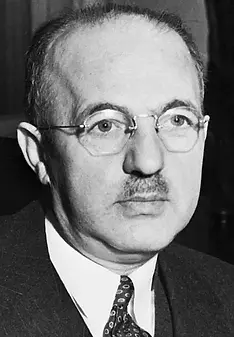
To the Right is a portrait of Dean Acheson who was of the core Wise Men. Acheson was an early architect of Cold War policies and played a key role in the initiation of WWII in the Pacific and the Korean War.

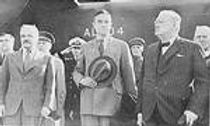
Harriman (center) with Molotov (Left) and Churchill (Right) possibly at 4th Moscow Conference in 1944 (ww2db.com)
.webp)
To the left is an image of George Keenan from 1947 (britanica) . Keenan wrote the "Long Telegram" which was a key event in the development of the Cold War and was the first to use the expression, "containment" with regard to the Soviet Union. He didn’t advocate trying to stop the advance of communism everywhere as a reasonable goal as it would cause the US to go bankrupt
Russia’s Objectives and European Communism
In trying to understand Russia’s objectives it’s important to first grasp the dramatically different cultural perspectives that existed in this developing conflict and not to project one’s side’s paradigms on the other. On the American side, in both the progressive “New Dealers” and the “Wise Men” and others who would ultimately drive Cold War policies, we have two competing internationalist or globalist visions. The decision makers on either side of the developing divide, however, were alike in many respects. They were from the elite ranks of American society as far removed from “ordinary people” as any collection of individuals could be and typically lived their lives around others of privilege. Collectively they were quite comfortable crafting the world that millions upon millions of people born and unborn would live in and, to the extent that most of them came from the cultural background of Yankee Protestantism, this wasn’t just a right conferred on them by their high birth but was a mission with religious or pseudo-religious implications.
Turning to Stalin, and those around him, we find someone who didn’t come from old money or privilege and didn’t care anything about a western internationalist world order or business profits. He didn’t see the culture or history of the Anglo-American elite to be superior to his own nor did he have any particular respect for the concepts of liberalism or hold western democracy to be an end in itself. He was first and foremost a Russian nationalist and in no way looked upon the West as some sort of “City on a Hill”. Harry Hopkins advised Truman, “Stalin is a forthright, rough, tough Russian. He is a Russian partisan through and through, thinking always Russia first. But he can be talked to frankly” (1 p. 60) If cooperating with Roosevelt and Stalin after the war would improve Russia’s security he was open to that but if not, he would plot his own course and he would have seen this in the context of Russia having been invaded by European forces several times in relatively recent history.
The Russians had a perspective on war that the British and especially the Americans lacked and that is of a people that had experienced total war on their own territory many times. The Russians lost over 10% of their total population and possibly as high as 14% in WWII. The British could hardly field 5 divisions at the start of the war and the Americans had less than 500K deaths in the war. The US had only two major wars fought on their own territory and, from the perspective of someone from the Northeast the Civil War and the wars against the Plains Indians that immediately followed could be considered foreign wars having been fought against people and cultures unlike their own and in regions far away. Stalin is said to have shown up at Yalta with a painting that at first appeared to be a peaceful Russian landscape but upon further examination depicted a Luftwaffe fighter plane flying off into the distance and a Russian boy almost obscured in the grass either dead or severely hurt and his dog howling. This is a perspective the others couldn’t fully appreciate. (22)
As the Russians drove the German forces, which included a significant number of non-Germans, out of Eastern Europe across Estonia, Latvia, Lithuania, Poland, Bulgaria, Hungary, Romania, Czechoslovakia, and Albania they didn’t simply liberate them, they occupied them. In fact they were not only occupied but Soviet style secret police systems were put in place to ensure they stayed under Soviet control (1 p. 55). This is indisputable but it should also be noted that prior to WWI the Russians controlled much of these areas and Poland and Czechoslovakia specifically were created as multi-ethnic nations coming out of WWI and were instrumental in the events that started WWII. In the era between the wars Poland invaded both Germany and Russia. A lesson learned from previous European invasions was the need for a large buffer zone and Stalin saw this cycle as being unavoidable (1 p. 54).
At Yalta the idea of security zones was somewhat vaguely agreed to but the American understanding of this was clearly much different from that of the Russians. Churchill had a more practical understanding. Churchill met alone with Stalin in Moscow prior to Yalta specifically to discuss keeping Greece aligned with England. Churchill started by saying, “Let us settle about our affairs in the Balkans,” and then continued, “Your armies are in Rumania and Bulgaria. We have interests, missions, and agents there. Don’t let us get at cross-purposes in small ways. So far as Britain and Russia are concerned, how would it do for you to have ninety per cent predominance in Rumania, for us to have ninety per cent of the say in Greece, and go fifty-fifty about Yugoslavia?” with this Stalin concurred. (1 p. 56) (23 p. 428) This represented long term historical factors. The idea of zones of influences or control was nothing new. The original treaty signed between Stalin and Hitler was built around this concept in Eastern Europe and when the Russian wanted to make substantial changes to the allocation of areas of interest that the Germans felt they couldn’t accept this which led to Barbarossa.
Russia had no intention of loosening their grip on Eastern Europe but this was far more practical than philosophical. Further, the US and the western allies had no military or economic alternatives for changing that. The key question facing the US at the time was, are they now attempting to spread world revolution? Spurred on largely by economic hardship, communism had made advances in Western Europe. In France, Italy, and Finland, 20 percent of the people voted communist (1 p. 68) but this was still a small minority. More importantly, Stalin had disbanded the Comintern that had been created to encourage communist revolutions in other countries as a concession to his WWII allies’ and US officials saw no evidence that the Soviets were encouraging communism in Western European nations. It was known that Stalin actually ordered Soviet agents not to agitate in France, Greece, and other Western nations (1 pp. 68-9).

This is a painting of a Russian landscape. In it you will notice a Luftwaffe plane flying away in the upper right and a young Russian man lying dead or wounded while his dog howls at the plane. Stalin is said to have brought this to Yalta to show the difference in perspective the Russians have on war from the British and Americans. Russia had been invaded several times from Europe and large wars fought on their territory. For the Americans and the British wars were foreign adventures and largely optional.
Building the Framework of Cold War Policy
After the successful atomic bomb test Byrnes and Truman now no longer wanted Russia to become involved with the war against Japan. After the first bomb was dropped on Hiroshima on August 6th of 1945 the Soviet Union moved up their invasion plan to occupy Manchuria by two weeks and then Truman quickly ordered the bombing of Nagasaki to try to force a quick surrender. The United States issued a declaration of unconditional surrender against Japan, with Great Britain and China as signatories but the Soviet Union was not mentioned (1 pp. 64-9).
Byrnes wanted to use the bomb to drive concessions from the Soviet Union. Soviet nuclear physicist Yuli Khariton recalled that the Russians saw the use of the bomb against Japan as “atomic blackmail against the USSR, as a threat to unleash a new, even more terrible and devastating war.” (1 p. 65) Stalin, however, wasn’t intimidated and reasoned that the US didn’t want another war and, at least in terms of the electorate that was certainly true. He is quoted as saying, “We cannot achieve anything serious if we begin to give in to intimidation or betray uncertainty.” (24 p. 97)
The Soviets were economically and even demographically devastated by the war and it was known within the Truman administration that it would take several years for them to build and test an atomic bomb. British commander Bernard Montgomery visited the Soviet Union and reported the Russians to be “very, very tired. Devastation in Russia is appalling and the country is in no fit to start a war.” Yet the Americans continued to be very worried about the Soviet Union but not because it was in a position to wage a war but because it existed. Michael Swanson summarized this saying:
“Truman and his advisers came to be deeply worried about the Soviet Union. But if it was in no position to wage war, then, you may wonder, what were they so worried about? What got the national security bureaucracy of the United States all worked up was the simple fact that the Soviet Union existed. It couldn’t do anything now, but maybe it would cause trouble later.” (1 p. 68) (25 p. 49)
Kennan saw the developing confrontation between the US or West and the Soviets as ideological as opposed to military and, seeing the Soviet society and economy as being full of contradictions, foresaw that it would eventually collapse on its own. Keenan didn’t advocate trying to stop the advance of communism everywhere as a reasonable goal as it would cause the US to go bankrupt (1 pp. 70-1).
Although some would still argue the second point he was largely correct in these predictions although it would take 50 years to come about.
Under Secretary of State Dean Acheson took a different position that would eventually be commonly dubbed the domino principle after Eisenhower used it in a speech on Vietnam as the French were facing final defeat at Dien Bien Phu. Referring specifically to Greece he said it would be “Armageddon” like “apples in a barrel infected by a rotten one” that would lead to the loss of Europe (1 p. 71). Stalin had already agreed at Yalta that Greece would remain aligned with England and were not agitating for revolution in Western Europe and specifically in Greece. Economic aid to Greece was a tough sell and Republican Senator Arthur Vandenberg told Truman he would have to “scare hell out of the American people” to get the congressional votes he needed and that’s exactly what he did. The speech was very well received and would turn into a political advantage for Truman. Presidential assistants Clark Clifford and James Rowe told Truman in a 43 page memo that the Soviet threat made a great political issue for him. “There is considerable political advantage in the administration in its battle with the Kremlin…..the worse matters get…the more there is a sense of crisis. In times of crisis, the American citizen tends to back up his President” (16 p. 157). Greek aid passed 67 to 23. Around this time Marshall replaced Byrnes as Secretary of State and allowed his name to be used for the Marshall plan to rebuild Western Europe.
Actively blocking the Soviets from expanding outside of their area of influence in Eastern Europe, which there was no evidence they were doing, would become known as the “Truman Doctrine”. Russian expansion would have been seen as being synonymous with Communism although that was largely not correct either. European Socialists and Communists were typically not Stalinist and would be more inclined to be Trotskyites that Stalin had purged. This distinction was also true of the American left, many of whom were reborn as new right conservatives. The Russians understood this but few Americans ever did. Lenin had written a book in 1921 titled “Left Wing Communism: An Infantile Disorder” where he saw no direct linkage or comparison between the Russian revolution and world communism (26 p. ch. 1). It is also important to note that at this point in time the isolationist Old Right that opposed the Cold War that was struggling for control of the Republican Party against the Rockefeller aligned Northeastern establishment wing making the Republicans the peace party of the era.
Limiting the spread of Communism drove the passing of the Marshall Plan in March of 1948 to rebuild and re-industrialize Western Europe which also integrated West Germany with France and other European states. While this defensive measure improved the security of one side it posed a threat to the other creating a “security dilemma” (1 p. 75). The Marshall Plan is frequently seen as bringing a miracle revival of European economies which, in turn, has commonly been associated with a capitalist economic system drawing the comparison to the impoverished conditions in Eastern Europe but there’s more to it than that. The US, as a result of Bretton Woods and having sustained minimal damage during WWII was in a position to provide this sort of aid and Russia was not. The scope of the problem faced in the west was also significantly smaller than in Russia or Eastern Europe whether measured in population, area, structures, or degree of damage and destruction. Finally the level of infrastructure that was there in the first place and remained again favored the West. This led to a confrontation in Germany over East and West Berlin as the Soviets didn’t want this economic dominance to extend eastward threatening control of the Soviet buffer states. The Soviets blockaded the roads and rail traffic in and out of West Berlin on June 24, 1948 but this blockade was eventually broken by the Berlin Airlift which went on for a year and was a humiliating defeat for Stalin. The contrast between East and West Berlin became iconic of the image of the relative economies during the Cold War period.
Molotov spoke of this time during the 1970’s claiming that the Americans were “trying to draw us into their company, but in the subordinate role. We would have got into the position of dependence, and still would not have obtained anything from them” (1 pp. 75-6). Stalin would never accept the role of a subordinate power and refused to join the Bretton Woods financial system. When Truman offered economic aid to Eastern Europe Stalin forced them to reject it. By the end of 1949 either Soviet or Communist expansion into Western Europe was not a realistic possibility yet the Cold War continued to accelerate.

To the Left is a picture of the Brandenburg Gate Monument which is iconic of the Cold War
This image is of the Berlin Airlift which went on for a year and was a humiliating defeat for Stalin. The economic comparison of East and West Europe came to be seen as a comparison of Capitalism superiority over Socialism but there were other factors. Russian along with Eastern Europe was where WWI was fought and was economically and demographically devastated. They came out of the war lacking capital that the US could provide to Western Europe.


This is an image of typical apartment housing in Eastern Europe and Russia during the Cold War. This is iconic of the differences in standard of living between east and west and was commonly referred to as "commie block housing". To a degree this does represent differences in economic systems but again there is a bit more to it. Housing units destroyed in Eastern Europe were very high relative to the rest of Europe and much of what was there before the war lacked plumbing and electrical to begin with.
Summary
As the war ended in 1945 most Americans anticipated returning to the lives they knew before the war but due to decisions made by people they didn’t elect for reasons that were never honestly conveyed to them, that wasn’t to happen. For most Americans living in 1945 outside of elite circles and urban centers life frequently resembled the 19th century more than it did the 20th but that was to change forever in some ways that were immediately apparent and others that would take decades to fully appreciate.
-
As opposed to demobilizing as had occurred after other wars, the nation would remain on a permanent war footing managed by a blending of large corporations, unelected federal officials, and military leadership in what would come to be known as the “military industrial complex”. This model would over time be applied to other industries that were entangled with the government
-
As opposed to being governed by elected officials who were servants of the electorate, the nation would increasingly be controlled by a “power elite” and the elected politicians would become servants of this ruling class. As opposed to being a secret conspiracy this happened relatively naturally and in plain sight. Educational and other public institutions would control entry to this level of society and ensure conformity to allowable thought.
-
All of this would require the ability to run consistent budget deficits and the Bretton Woods financial structure enabled this by tilting the economic playing field in favor of the US. It would put into motion gradual economic changes that would financialize and eventually de-industrialize the economy.
-
Americans would be told and eventually accept the notion that we were under a constant existential threat from a godless external enemy that sought to control the world and destroy both liberty and Christianity. Anyone challenging that notion would be marginalized and silenced.
-
The initial Cold War strategic maneuvers in Europe, in the Marshall Plan and the Berlin Airlift, would go well for the West and America but Europe was only one theatre. In Asia things would not go nearly as well and would entangle the US in decades of conflict with no clear end game or way out.
Footnotes:
[1] Kerr was a fairly renowned bisexual which was a point of information probably not lost on his Soviet hosts.
[2] The phrase wasn’t used until after the Kennedy assassination and was then weaponized against those that questioned that didn’t accept institutionally acceptable explanations of events.
[3] Democracy in this sense specifically refers to elections where the choices and vote tabulation is controlled as to constrain the outcomes and ensure populist candidates do not obtain power.
Bibliography
1. Swanson, Michael. The War State: The Cold War Origins of the Military Industrial Complex and the Power Elite. South Carolina : Create Space, 2011.
2. Higgs, Robert. Depression, War, and Cold War . Oakland : The Independent Institute, 2006.
3. Beard, Charles. President Roosevelt and the Coming of War. New Jersey : Transaction Publishers, 2003.
4. Burckhardt, James. Force and Freedom. New York : Pantheon Books, 1943.
5. Mills, C. Wright. The Power Elite. New York : Oxford University Press, 1956.
6. Campbell, Craig and Lovegail, Fredrick. America's Cold War. Cambridge : Belknap Press, 2009.
7. Rothbard, Murray N. What Has Government Done to Our Money. Auburn, Alabama : Mises Institute, 1991.
8. Roosevelt, Elliott. As He Saw It. New York : Duell, Sloan, and Pearce, 1946.
9. Talbot, David. The Devil's Chessboard. s.l. : Harper Perennial, 2016.
10. Rothbard, Murray N. A History of Money and Banking in the United States. Auburn Alabama : Misses Institute, 2002.
11. Cummings, Bruce. The Origins of the Korean War Vol II. New Jersey : Princeton University Press, 1990.
12. Rothbard, Murray N. America's Great Depression. Auburn Alabama : Misses Institute, 1963.
13. Costigliola, Frank. Roosevelt's Lost Alliances: How Person Politics Helped Start the Cold War. New Jersey : Princeton University Press, 2012.
14. Fleming, Thomas. The New Dealers War. New York, New York : Basic Book, 2001.
15. Isaacson, Walter and Thomas, Evan. The Wise Men; Six Friends and the World They Made. New York : SImon and Schuster, 1986.
16. Moskin, Robert. Mr Truman's War. New York : Random House, 1996.
17. Costigilola, Frank. Roosevelt's Lost Alliances. 2012.
18. Schlesinger seminar. Schlesinger, Arthur. 1967.
19. Abramson, Rudy. [interv.] Elie Abel. September 17, 1981.
20. Forrestal, Michael V. Review: The Wise Men: Six Friends and the World They Made. Foreign Affairs. Winter 1986.
21. Akiboh, Alvita. No Anecdotes are told of Elihu Root: America's 20th Century Wise Man. US History Scene.
22. Martyanov, Andrei. Reminiscence of the Future. [Online] December 4, 2024. https://smoothiex12.blogspot.com/.
23. Hoover, Herbert. Fredom Betrayed. s.l. : Stanford University Press, 2011.
24. Campbell, Craig and Radchenko, Sergey. The Atomic Bomb and Origins of the Cold War. New Haven : Yale University Press, 2008.
25. Zubok, Vladislav. A Failed Empire: The Soviet Union in the Cold War from Stali to Gorbachev. Chapel Hill : University of North Caroilina Press, 2009.
26. Lenin, N. Left Wing Communism: An Infantile Disorder. Dearborn Michigan : The Marxian Educational Society, 1921.